

Everyone has seen a bug escape into production on a Friday night. An SDET treats that as an engineering failure, not bad luck.
What exactly is an SDET?
SDET stands for Software Development Engineer in Test. In plain terms, it is a software engineer whose specialty is quality. This is not someone who "tests after everything is finished"—it is someone who builds the tools, frameworks, and automation that make quality happen consistently and repeatedly.
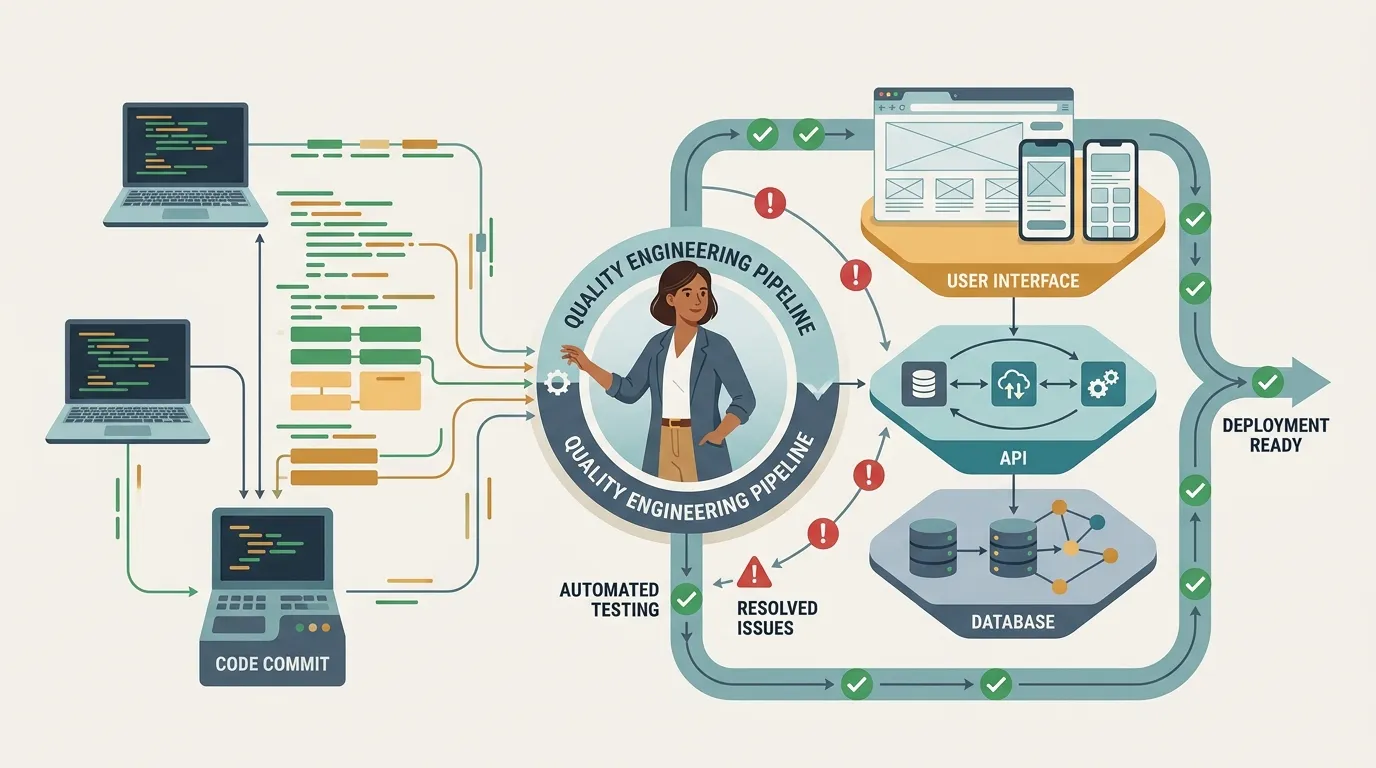
The central idea is this: an SDET writes code to test code. And they look at the entire product—API, database, queue, frontend, pipeline—not just the screen.
An SDET is not a manual QA tester with a different title
Manual QA and SDET share the same goal—a product that works—but their methods are different. Manual QA explores the system as a user, finds the unexpected, and validates flows and the user experience. This is valuable work, and it is not going away.
The SDET takes what is repetitive and deterministic and turns it into code that runs on its own with every commit. A regression that used to take two hours of clicking becomes two minutes in the pipeline. The difference is not about one being "better" or "worse": it is manual and exploratory work on one side, and automation and infrastructure on the other.
And an SDET is not just the developer who writes tests
Every good developer writes unit tests for their own code. That does not make them an SDET. The focus changes the perspective.
The product developer thinks, "How do I make this work?" The SDET thinks, "In how many ways can this break, and how do I prove that it has not?" They work at the boundaries: integration between services, test data, environments, API contracts, and flakiness. They build the test harness that the entire team uses. It is real software development—the only difference is that the "product" is confidence in the system.
The mindset: quality is an engineering problem
This is where the heart of the role lies. Quality is not a final step; it is a property designed into the product from the beginning.
The SDET thinks in terms of risk: what hurts most if it breaks? Where is it worth investing in automation, and where is it not? They hate tests that pass when they should fail and tests that fail for no reason—noise destroys trust. They are critical by profession: they assume that anything can break and design systems to detect failures quickly when they happen. It is applied skepticism, not pessimism.
The skills the role demands
In practice, an SDET needs:
- Real programming skills. Proficiency in one language—Python, Java, or JS/TS, for example—data structures, and clean code. Poor automation becomes technical debt.
- Automation and frameworks. Playwright, Selenium, and Cypress on the frontend; API and contract testing; building abstractions instead of merely scripting clicks.
- CI/CD. A test that does not run in the pipeline barely exists. You need to understand GitHub Actions, GitLab CI, parallelization, and merge gates.
- Fundamentals. HTTP, databases, Docker, and at least some networking and observability. To test the system, you need to understand the system.
You do not need to master everything on day one. You do need to be willing to keep learning, because the role touches every part of the stack.
Where does the career begin?
There are two common paths. Some people come from manual QA and learn to program, gradually replacing clicks with code. Others come from development and shift their focus toward quality and test infrastructure. Both paths work.
An honest starting point is to automate a flow you currently test by hand. Then put it in CI. Then make it reliable. The progression can lead from junior to senior SDET and then to quality specialist or SET, while an engineering foundation can also open doors to platform engineering and SRE.
An SDET is not a "turbocharged" QA tester or a "second-rate" developer. It is the discipline of making software prove, on its own and all the time, that it still works. If Friday nights make you shudder, this role is about sleeping peacefully.