
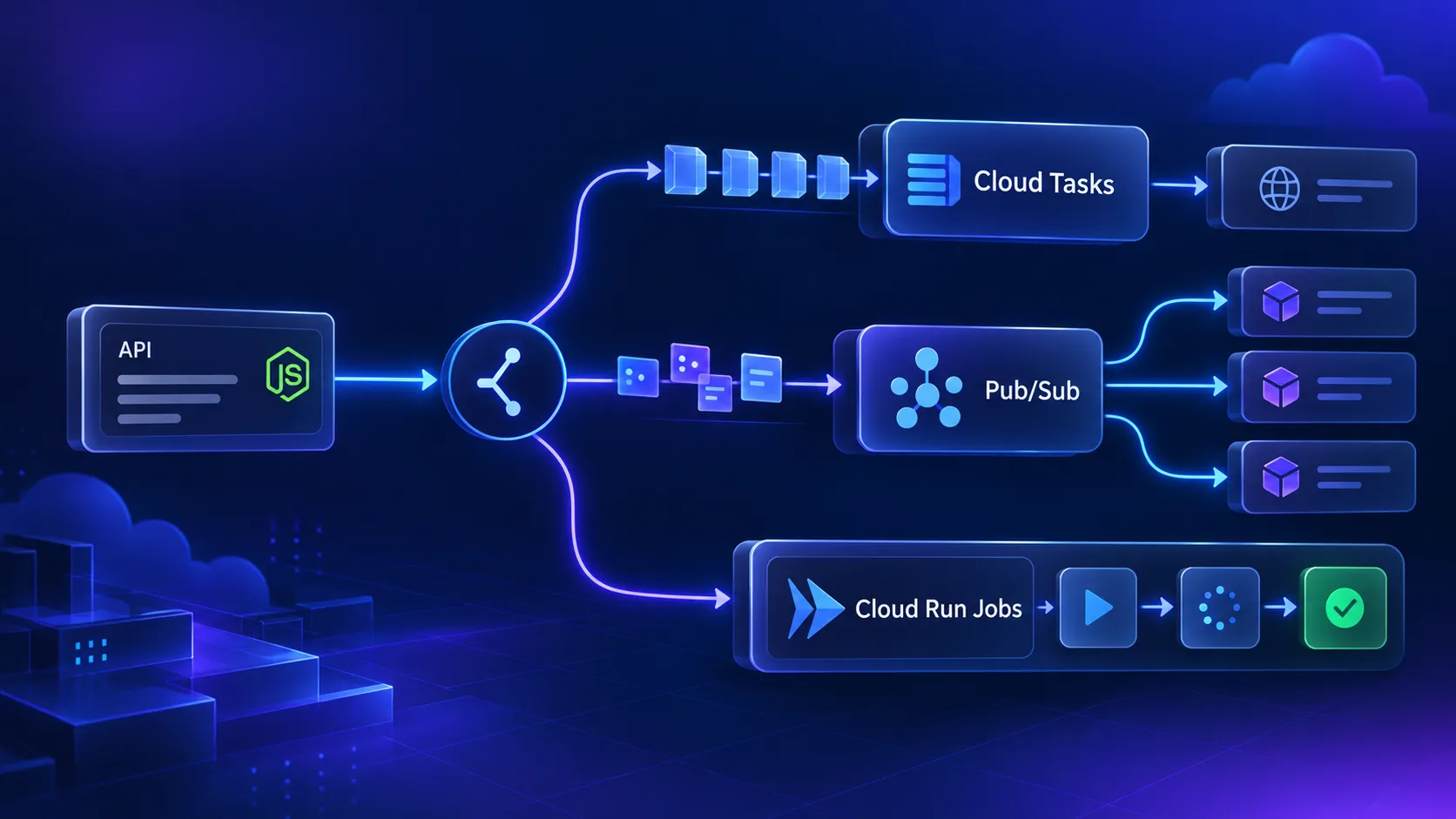
In distributed systems, it is common to summarize any work outside the main flow as “asynchronous.” From there, the discussion often quickly moves to “let’s put it in a queue,” “let’s publish it to a topic,” or “let’s run a job.”
However, asynchronous processing on GCP does not start with the tool. It starts with the contract.
Before choosing between Cloud Tasks, Pub/Sub, and Cloud Run Jobs, it is worth answering: who is initiating the work? Who needs to react? Is the destination known? Does the execution need to finish as a finite unit? And, most importantly: what happens when something fails halfway through?
Cloud Tasks, Pub/Sub, and Cloud Run Jobs solve similar problems on the surface, but very different problems at the business-contract level. Once this difference becomes clear, the architecture tends to be easier to operate, easier to observe, and less dependent on the hope that “the queue will solve it.”
TL;DR
- Use Cloud Tasks when an application needs to request a specific action from a known destination, typically an HTTP handler.
- Use Pub/Sub when the system needs to communicate that something happened and allow independent consumers to react.
- Use Cloud Run Jobs when the work is finite, batch-oriented, or operational, and needs to run until it completes or fails.
- Retries do not mean exactly-once execution. Handlers, consumers, and jobs need to handle duplicates, partial effects, and reprocessing.
- In real-world flows, the three services can coexist: a task initiates an action, an event communicates the confirmed fact, and a job later reconciles discrepancies.
Asynchronous processing on GCP starts with the contract, not the tool
The first question should not be “which GCP service should we use?” It should be: what is the intent of this operation?
In practice, there are at least three very different architectural intentions:
-
Command an action for a known destination.
Example: “request payment for this invoice at this endpoint.” -
Publish a fact for independent interested parties.
Example: “payment for this invoice has been confirmed.” -
Execute finite work that needs to reach completion.
Example: “reconcile all of yesterday’s payments with the external provider.”
These three intentions can be asynchronous, but they do not necessarily call for the same mechanism.
“Asynchronous” only means that the work does not need to finish within the immediate flow of the person or system that initiated the operation. By itself, this does not tell you whether you need an HTTP task queue, an event bus, or a controlled batch execution.
A common mistake is choosing the service because it already exists in the project. “We already have Pub/Sub, so let’s publish a message.” “We already have Cloud Tasks, so let’s create a task.” This decision may seem pragmatic at first, but it can hide an important question: what contract exists between the producer and the consumer of this work?
If that contract is not explicit, the tool becomes a detail. And details do not sustain reliability.
Cloud Tasks: when an application needs to request a specific action
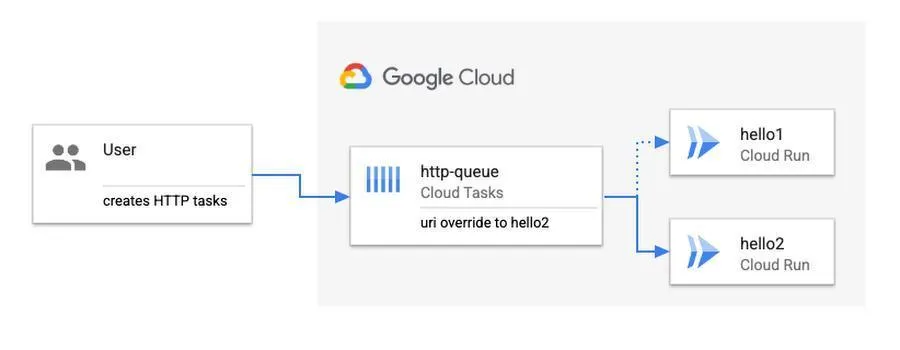
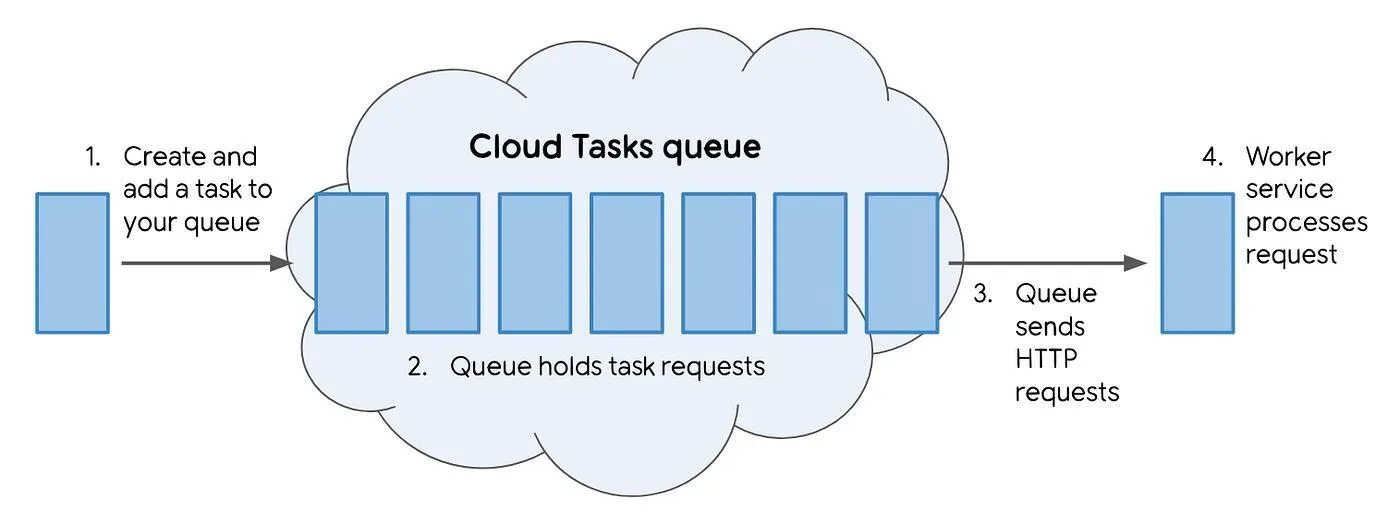
Cloud Tasks is a good choice when an application needs to create a task to be delivered to a known HTTP handler, with control over scheduling, rate, concurrency, and retries.
The mental model is: “I know which action needs to happen and who should execute it, but I do not want to do it within the original request’s response.”
Typical scenarios include:
- Starting a charge after an order is confirmed.
- Requesting payment for an invoice that has already been created.
- Sending a notification to a specific user.
- Calling an external integration without blocking the API response.
- Executing an action at a future time.
The relationship with Cloud Run is usually direct: Cloud Tasks sends an HTTP request to an endpoint exposed by a Cloud Run service. That service processes the request and responds with success or failure. The response matters because it tells the infrastructure whether that delivery can be considered complete or should be retried.
A simplified flow could be:
- The API receives the order confirmation.
- The API persists the order and the essential state of the payment intent.
- The API durably records that there is a payment action to execute.
- The task is created to call the endpoint responsible for initiating the payment.
- Only then does the API respond to the client with a consistent state.
The important point lies between steps 2 and 4. It is not enough to “save to the database and then try to enqueue” as if nothing could fail in between. If the application persists the order, fails before creating the task, and still returns success, there may be pending work without operational traceability.
A common way to handle this is to persist a processing intent, such as a pending payment attempt, and have some reliable mechanism to create or recreate the task if the call to Cloud Tasks fails. Depending on the context, this could be an outbox pattern, a reconciliation routine, or a state transition that makes pending work visible for reprocessing.
A Node.js example, without going into SDK details, could follow this idea:
js app.post("/orders/:id/confirm", async (req, res) => { const orderId = req.params.id;
const result = await db.transaction(async (tx) => { const order = await tx.orders.confirm(orderId);
const paymentAttempt = await tx.paymentAttempts.create({
  orderId,
  status: "pending",
  provider: "external-provider"
});

await tx.processingIntents.create({
  type: "start_payment",
  referenceId: paymentAttempt.id,
  status: "pending_task_creation"
});

return { order, paymentAttempt };
});
await createCloudTask({ url: "https://payment-service.example/internal/start-payment", payload: { order_id: result.order.id, payment_attempt_id: result.paymentAttempt.id } });
await db.processingIntents.markTaskCreated({ referenceId: result.paymentAttempt.id });
res.status(202).json({ order_id: result.order.id, payment_attempt_id: result.paymentAttempt.id, status: "payment_scheduled" }); });
This example is still simplified. In production, you would need to think about what happens if createCloudTask succeeds and the markTaskCreated update fails, or if task creation returns an error after the task has actually been created. The exact design depends on the system, but the general rule remains: the processing intent needs to be durable and traceable.
Cloud Tasks is particularly helpful when you need:
- Scheduling: deliver the task now or at a future time.
- Rate limits: control the pace of calls to protect an internal or external service.
- Concurrency: prevent too many tasks from being processed at the same time.
- Retries: try again when the handler fails.
- Request execution deadline: limit how long the handler has to respond.
The trade-off is that the producer knows the action’s destination. This simplifies the flow, makes it easier to trace “who told whom to do what,” and fits well with explicit commands. On the other hand, it creates direct coupling between the enqueuer and the executor.
The main precaution is: do not treat the handler as if it were called only once. It may receive duplicate deliveries. It may fail after executing part of the work. It may call an external provider and lose the response. If the operation has a significant business effect, the handler needs to be idempotent and able to resume an incomplete attempt.
Pub/Sub: when the system needs to communicate that something happened
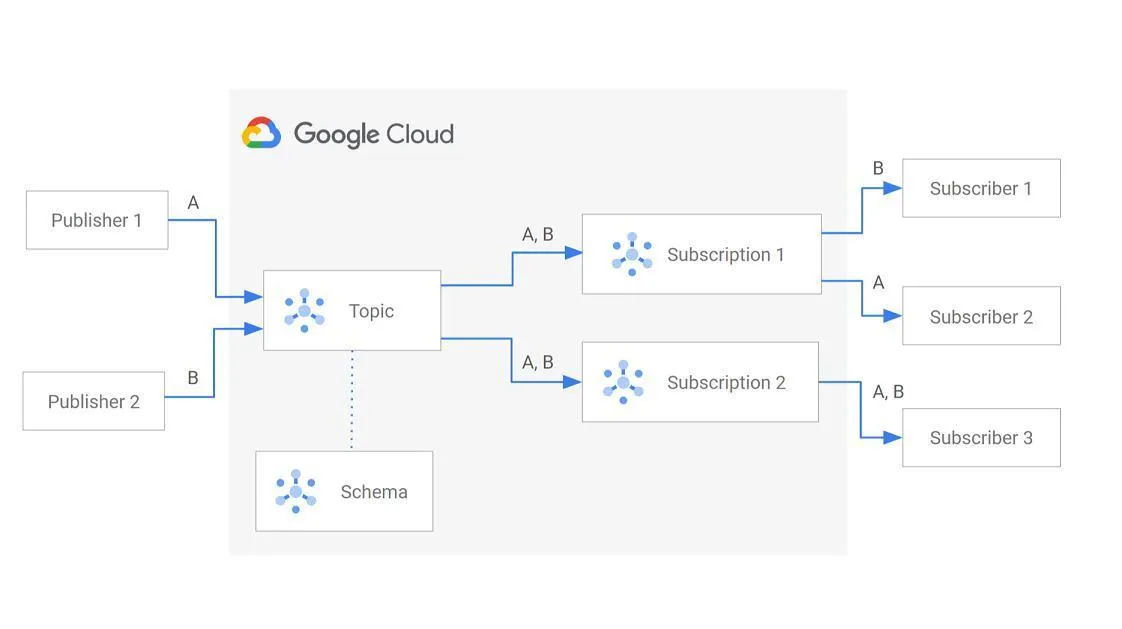
Pub/Sub is a better fit when the system needs to publish an event: something relevant happened, and different parts of the architecture may want to react.
The difference between a command and an event is subtle but important:
- Command: “send this payment to this destination.”
- Event: “the payment has been confirmed.”
In a command, someone is requesting a specific action. In an event, someone is announcing that a fact has occurred.
Pub/Sub is useful when multiple consumers can independently react to the same business fact:
- A created order triggers notifications, analytics updates, and CRM synchronization.
- A confirmed payment updates the balance, issues a tax document, and feeds communication flows.
- A customer change triggers integrations with independent systems.
Imagine an order service that publishes OrderCreated. One subscription processes inventory. Another sends a welcome campaign. A third feeds an analytics system.
The producer does not need to know these consumers. It publishes the business fact and continues its flow. Each subscription has its own processing lifecycle, failures, and evolution.
This provides a clear advantage: new consumers can be added without changing the producer. In addition, a failure in one consumer does not need to prevent the others from receiving the event.
But this freedom comes at a cost. Pub/Sub reduces coupling between producers and consumers, but it requires more discipline around:
- message contracts;
- event versioning;
- traceability across services;
- observability of distributed flows;
- duplicate handling;
- clear semantics about what the event actually means.
A common mistake is publishing messages that are, in practice, internal instructions for a single service. For example: SendPaymentToProviderCommand published to a topic consumed by only one known worker. This may work, but you may have turned a targeted action into an artificial event, adding complexity without gaining real independence.
The useful question here is: does the producer really need to know who will consume this information?
If the answer is “no, several interested parties may react to this fact,” Pub/Sub tends to make sense. If the answer is “yes, I need that service to execute this specific action,” Cloud Tasks may represent the contract more accurately.
Cloud Run Jobs: when the work is finite and does not fit within a request lifecycle
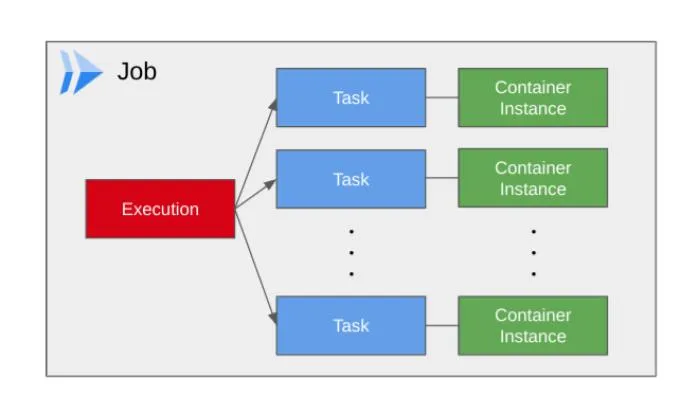
Cloud Run Jobs solves a different type of problem. Instead of keeping an HTTP service available to respond to requests, you run a container until it completes.
The mental model is: “there is finite work, with a beginning and an end, that needs to run until it completes or fails.”
Examples include:
- Reprocessing historical data.
- Generating reports or consolidated files.
- Importing a dataset received from a partner.
- Running payment reconciliation.
- Performing controlled operational migrations or batch tasks.
The difference from a Cloud Run service is the lifecycle:
- A service responds to requests.
- A job starts an execution and ends when the work completes or fails.
Consider a payment reconciliation routine. The system has internal payment records, but it also needs to compare those records with the external provider. A job can retrieve confirmed payments from the provider, compare them with the internal database, and generate a list of discrepancies for handling.
This is not exactly an individual event. It is also not a deferred HTTP call to a specific handler. It is a finite process of scanning, comparing, and producing a result.
Cloud Run Jobs also lets you think about parallelism. You can split a workload into multiple job tasks when:
- the volume is large;
- the items are relatively independent;
- there is a clear way to partition the work;
- the routine supports partial reruns.
On the other hand, sequential execution may be better when:
- operational simplicity matters more than speed;
- there are dependencies between steps;
- the volume is manageable;
- process consistency matters more than parallelism.
The trade-off is that jobs are excellent for finite and controlled processing, but they do not replace an event delivery mechanism or an HTTP action queue.
A warning sign is using one job for every individual high-volume event. In that case, you may be turning a continuous consumption need into many isolated executions, increasing operational cost and making observability more difficult.
Comparing the choices: intent, destination, consumers, and execution lifecycle
The table below is not a mechanical rule. It is a starting point for discussing intent, contracts, and failures.
| Criterion | Cloud Tasks | Pub/Sub | Cloud Run Jobs |
|---|---|---|---|
| Primary intent | Request an action | Communicate an event | Complete finite work |
| Destination | Known by the producer | Independent subscriptions | Container execution |
| Consumers | Typically one handler per task | One or more consumers | One process or a set of job tasks |
| Scheduling control | Strong | Depends on the consumer/architecture | Can be triggered on demand or by another mechanism |
| Retries | Focused on task delivery | Focused on consumption by the subscription | Focused on work execution |
| Delivery and duplicates | At least once; handler must be idempotent | At least once by default; consumer must handle duplicates | Retries per job task; the routine must support safe reruns |
| Best for | Reliable deferred HTTP calls | Fan-out and decoupled integration | Batch processing, reprocessing, and finite routines |
A simple way to guide the decision is to answer these questions:
- Am I requesting an action or announcing a fact?
- Does the producer know and need to control the destination?
- Do one or multiple consumers need to react?
- Does the work fit within the time of an HTTP request?
- Do I need to schedule, limit the rate, or control concurrency?
- If a failure occurs, what does reprocessing mean?
The last question often reveals more than it seems. If reprocessing means “call the same endpoint again with the same intent,” Cloud Tasks may be a good fit. If it means “each consumer decides how to handle the same fact,” Pub/Sub is more natural. If it means “run a finite routine again from a known state,” Cloud Run Jobs may be the right path.
The important thing is not to choose Pub/Sub only because it seems more “decoupled.” Decoupling is not the absence of a contract. Sometimes the domain needs an explicit, traceable, targeted action.
Retries, reprocessing, and idempotency: the contract must survive failures
Retries do not mean that the system will execute something exactly once. In general, they mean that it will attempt to deliver or execute it again when something appears to have failed.
But what happens if the call fails halfway through?
Imagine a handler that initiates a charge with an external provider. It may:
- call the provider and receive success;
- call the provider and receive an error;
- call the provider, have the provider process the payment, but lose the response;
- persist the local result and fail before responding to the infrastructure;
- respond with success too early and lose a relevant failure afterward.
That is why idempotency is not merely a technical detail. It is a property of the business operation.
Examples include:
- Retrying the same charge must not generate a second improper charge.
- Resending the same notification may require a deduplication key or delivery identifier.
- Reprocessing an event must not corrupt the aggregate state.
- Running reconciliation again should not duplicate discrepancies that have already been recorded.
An identifier such as payment_attempt_id can help significantly, but it is not an isolated magic solution. It needs to be associated with a rule persisted in the database, such as a uniqueness constraint, a state machine, or an attempts table with well-defined transitions.
Whenever possible, this same identifier should also be used as the idempotency key in the integration with the external provider. This way, multiple attempts at the same operation are more likely to be recognized as the same intent rather than as independent new charges.
A safer flow could follow this idea:
- Create
payment_attempt_idin the database with apendingstatus. - Send the request to the provider using this identifier as the idempotency key.
- Persist the received result or an intermediate state sufficient for reconciliation.
- Return success to the infrastructure only when the required effect has been confirmed or when enough state has been persisted to safely resume and reconcile the operation.
This last point is important. The handler should not return success merely because it “received the message.” It should return success when the essential part of the contract has been fulfilled or when the system has enough state to avoid losing the operation.
It is also useful to separate three decisions:
-
When should we retry?
Transient errors, timeouts, and temporary unavailability may justify retries. -
When should we stop and route the issue for analysis?
Validation errors, domain inconsistencies, or unexpected responses may require intervention or specific handling. -
How should we reprocess after fixing a systemic failure?
If a bug affected several items, recovery may require a job rather than infinite item-by-item retries.
The more automatic the retry, the greater the responsibility to protect external services from duplicates, overload, and irreversible effects.
It also helps to include business identifiers and enough metadata for diagnosis in payloads: order_id, payment_attempt_id, event_id, correlation_id, contract version, and message origin. Logs are important, but they should not be the only place where the operation exists.
Combined architectures: the three services can coexist
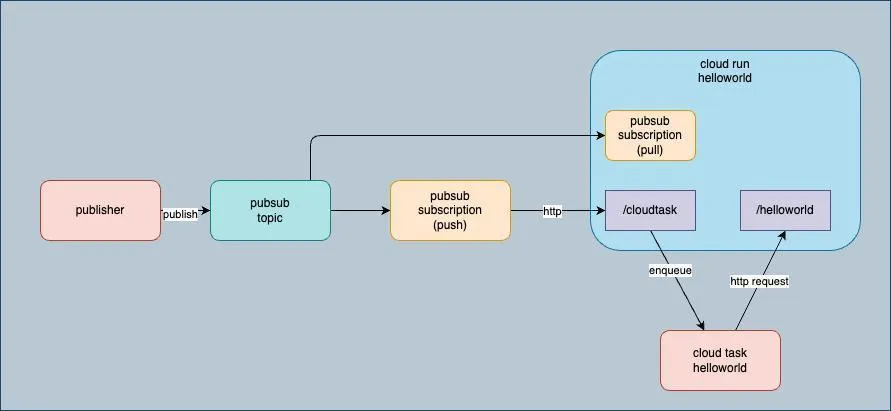
Cloud Tasks, Pub/Sub, and Cloud Run Jobs do not need to compete with one another. In many systems, they appear together because they solve different contracts within the same flow.
A payment flow could look like this:
- The API records the order and creates a Cloud Tasks task to initiate the payment.
- The handler processes the payment attempt and confirms the result.
- After confirmation, the service publishes an event to Pub/Sub.
- Independent consumers react to the confirmed payment.
- A periodic reconciliation routine runs as a Cloud Run Job to identify discrepancies with the payment provider.
In Mermaid, the flow could be represented as follows:
mermaid flowchart LR API[Order API] --> DB[(Essential persisted state)] API --> CT[Cloud Tasks] CT --> PAY[Payment handler on Cloud Run] PAY --> EXT[External provider] PAY --> TOPIC[Pub/Sub: PaymentConfirmed] TOPIC --> BAL[Balance update] TOPIC --> DOC[Tax document] TOPIC --> COM[Customer communication] JOB[Cloud Run reconciliation job] --> EXT JOB --> DB
Another common flow involves partner integrations:
- A customer-change event is published to Pub/Sub.
- A consumer receives the event and creates Cloud Tasks tasks to respect the request limit of a partner API.
- Each task calls the external integration at the permitted rate.
- Accumulated failures are analyzed and reprocessed by a Cloud Run Job.
In this design, Pub/Sub communicates the fact, Cloud Tasks controls targeted calls, and Cloud Run Jobs helps with operational recovery.
A simple checklist:
- Action for a known destination: consider Cloud Tasks.
- Relevant fact for multiple interested parties: consider Pub/Sub.
- Finite, batch, or controlled reprocessing process: consider Cloud Run Jobs.
- More than one of these needs in the same flow: combine the services while preserving clear contracts.
Ultimately, architectural maturity is not about “using a queue.” It is about making the business contract, failure behavior, reprocessing strategy, and limits of each tool explicit.
To discuss architectural decisions and trade-offs with other professionals, follow the SCCB community on Instagram.