

Everyone talks about “getting into tech” as if it were one single place. It isn’t. It’s an entire continent, with regions that operate by different rules. Before choosing where to run, it’s worth opening the map.
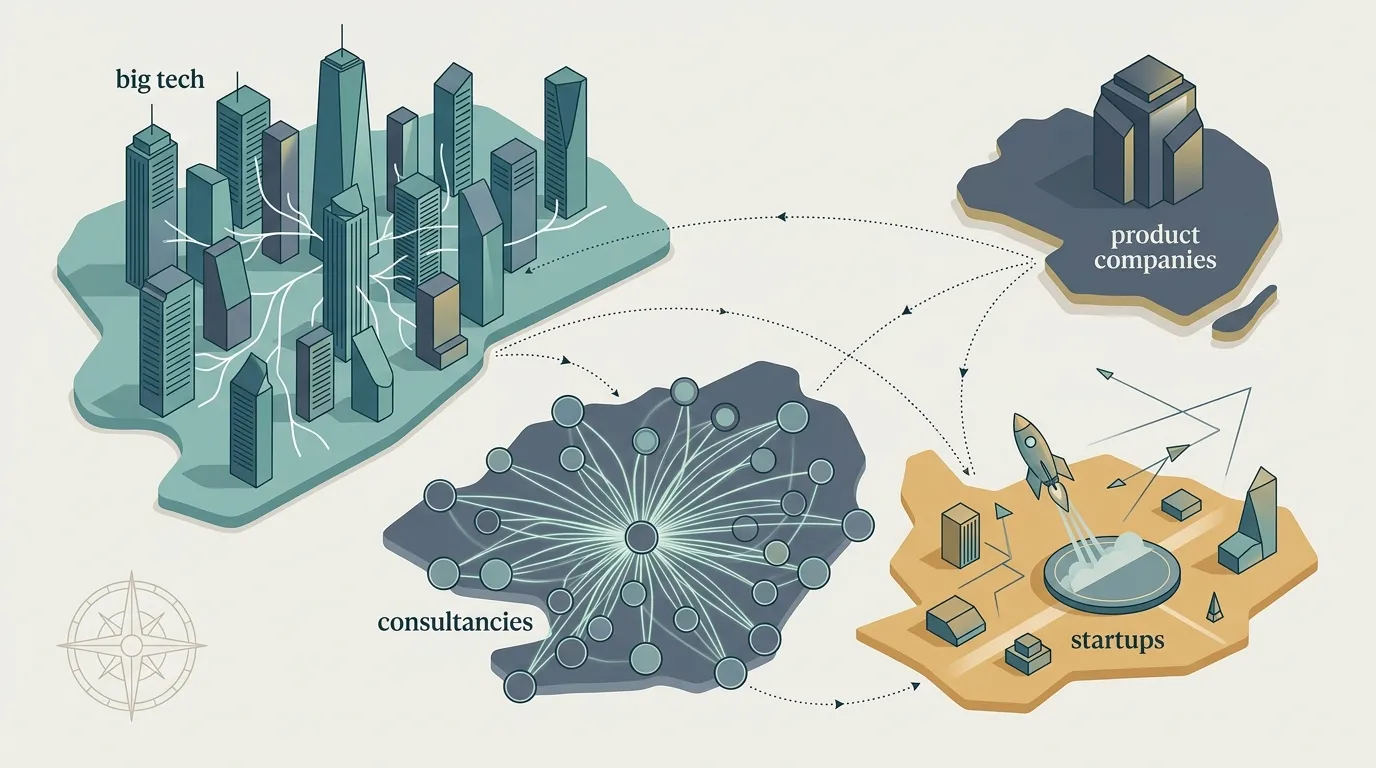
Startups, big tech, consulting, product companies: who’s who
A startup gives you broad scope along with chaos: you touch everything, learn quickly, and take on risk—including the risk that the company might shut down. Big tech pays well, has mature processes, and turns you into a specialist in a small part of a massive system. Consulting puts you on client projects: high variety, but you deliver what was sold, on someone else’s timeline. A product company lives on its own software: a steadier cadence and a stronger sense of ownership, if the product is healthy. None is better. They demand different things from you.
Junior, mid-level, senior: what really changes
The difference between levels isn’t how much code you write; it’s how much uncertainty you can handle on your own. A junior executes well-defined tasks and needs context. A mid-level professional solves the entire problem without someone holding their hand. A senior chooses which problem is worth solving, anticipates what will break, and unblocks other people. Titles inflate and lose value quickly: “senior” at one company is “mid-level” at another. Look at the actual responsibility, not the word on the nameplate.
CLT, PJ, remote, international: the arrangement shapes everything else
CLT employment brings predictability and legal benefits; PJ contracting brings a larger gross figure, while taxes, vacation, and unexpected expenses are your responsibility. Remote work opens up the entire market, but it demands discipline and written communication. Working for an international company pays in a stronger currency and looks irresistible on a spreadsheet—until you add time zones, contract-related bureaucracy, and the insecurity of being the first to be cut when exchange rates or the overall climate change. The arrangement isn’t a footnote: it defines your risk, your routine, and how much of your salary is actually yours.
What the market values today—and what has become a commodity
Knowing a language’s syntax has become the minimum, not the differentiator. What gets rewarded is the ability to take something from a poorly defined problem to a working production system without breaking everything else. Understanding the business, writing clearly, working with AI as a tool instead of competing with it, and having real depth in something rather than superficial knowledge of half a dozen technologies. Certifications and lists of buzzwords count for little. Evidence that you deliver counts for a lot.
How to read the map before taking the next step
No point on the map is a final destination. A startup junior becomes a product mid-level professional; a big tech senior starts a consulting firm. The mistake isn’t choosing the wrong region—it’s moving without knowing that other regions exist. Now that you’ve seen the whole map, the next question is no longer “how do I get into tech?” but “which part of it do I want to be in—and what will it demand from me?” That’s a much better question.