

SEO keyphrase: backend stack choice in the AI era
TL;DR
AI has made it easier to start projects: today, anyone can put together an “okay” backend over a weekend, in almost any language. That has only increased the importance of backend stack choice in the AI era. Now that it is cheap to fail fast, it is common to get stuck with products that do not scale well or are difficult to maintain. This article is not about which stack is “best,” but about how to choose carefully by considering the product context, operations, team, and evolution horizon.
1. Introduction: the wrong debate about backend stacks
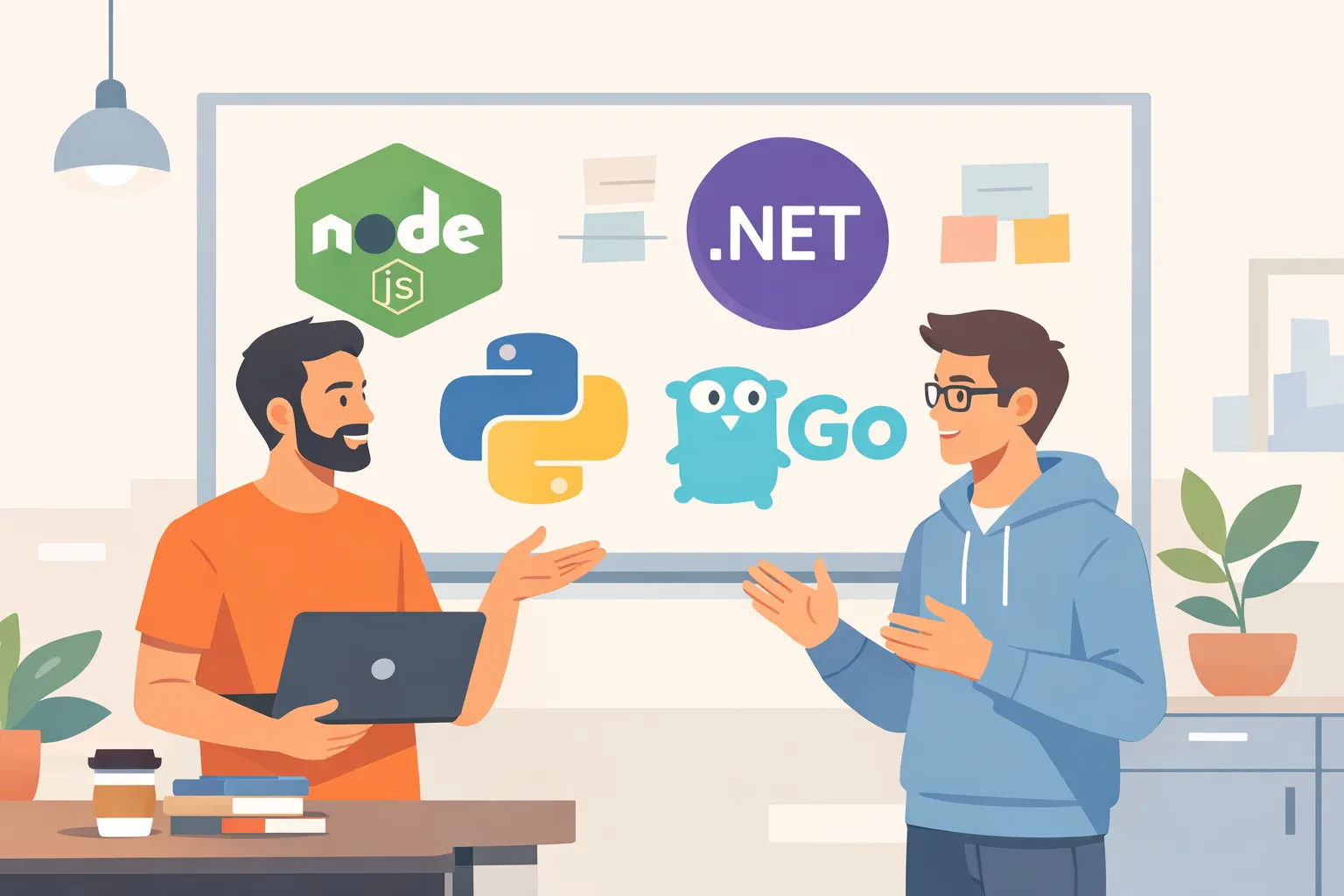
If you have ever taken part in technology discussions, you know how it goes: a team debating “Node vs. .NET vs. Python vs. Go,” endless Slack threads, benchmark charts thrown into the conversation here and there, and someone always bringing up Netflix or Google as an argument.
Spoiler: that is the wrong debate.
AI has made this scenario even more complicated. Today, asking a model to create a REST API in almost any stack is easy. This convenience makes it tempting to follow the easiest path or try the stack of the moment because AI supposedly helps people learn it.
But putting together a weekend project that handles a few requests is very different from supporting a real product with continuous evolution, production bugs, an SLA, a changing team, and business requirements that only become more complicated.
The idea is simple: backend stack choice is now more about product context + operations + team. AI accelerates the beginning, but it does not keep the house in order.
2. What AI has really changed—and what it has not
2.1. Getting started has become cheaper
AI has genuinely made it easier to get projects off the ground. A beginner developer can, without much mystery, ask:
- “Create a REST API in C#/.NET with JWT authentication and basic tests”; or
- “Generate a Python API with FastAPI for product CRUD operations.”
And there it is: a functional skeleton with a folder structure, controllers, routes, and even build scripts. It is as if AI were a factory for examples and tutorials.
It has also become more accessible to experiment with new stacks. Where it once took hours of reading documentation, now you can simply ask for:
- ready-to-use snippets with specific libraries;
- explanations of how to configure a basic project;
- test examples and even an initial docker-compose file.
But this benefit comes with a trade-off: when getting started is cheap, it becomes easy to get attached to an “okay” prototype and try to build on it without considering whether it will be worthwhile in the long term.
2.2. But engineering still matters
Behind code that “works” are engineering decisions that AI still does not handle well:
- Domain modeling and boundaries: you need to decide where to separate contexts and responsibilities.
- Architecture: knowing when to use a modular monolith, microservices, CQRS, and other approaches.
- Production performance: dealing with bottlenecks, latency, query optimization, and caching.
- Observability and reliability: metrics, structured logs, tracing, and failures.
- Infrastructure cost: sizing instances and planning for scalability.
An unsuitable stack amplifies problems such as:
- high latency under workloads that require fast responses;
- infrastructure costs that spiral;
- difficulty hiring people who understand the stack;
- reduced productivity due to a lack of expertise in the ecosystem.
2.3. The mistake of deciding based on preference, hype, or an isolated benchmark
Today, it is even more common to see stack choices driven by personal preference, hype, or isolated benchmarks—which can be quite dangerous:
- Personal preference: “Let’s use X because I already know it and like it.”
- Hype: “Everyone is using Y with AI now.”
- Synthetic benchmark: “Hello World per second” charts treated as the deciding argument.
Benchmarks are useful, but they do not reflect your product’s real workload. What matters is the context:
- product type;
- business maturity;
- nontechnical constraints.
3. Criteria that really matter when choosing a backend stack

3.1. Product and business context
First, ask: What problem does this backend need to solve?
Consider:
- Is the workload more about a high-concurrency API or batch processing?
- Is your product more data-intensive or I/O-bound?
- What are the latency and throughput requirements?
- Is it an exploratory MVP or a core product?
For exploratory MVPs, shortcuts are acceptable if you know that a rewrite will be unavoidable.
3.2. Team, community, and ecosystem
A stack is not just technology; it is also what your team can operate. If the team already has experience with JavaScript/TypeScript, insisting on an exotic stack can lead to:
- a long learning curve;
- more difficult code reviews;
- uncertainty when working on critical parts.
Also consider the ecosystem:
- Are mature libraries available?
- Is the documentation good?
- Is there an active community?
3.3. Productivity and maintenance over time
Productivity is not limited to the first endpoint. It also includes:
- learning curve;
- conventions that prevent poor decisions;
- code clarity;
- design patterns that make refactoring easier.
AI helps write code, but it does not replace a stack that encourages readable, well-organized code.
3.4. Operations, cost, and infrastructure
Today, every backend needs to work with:
- Kubernetes, serverless, PaaS, and on-premises environments;
- observability tools;
- the company’s cloud services.
The stack needs to fit into this ecosystem. Ask:
- What is the runtime cost?
- Are there good debugging and tracing tools?
- Does your cloud provider offer better support for a specific stack?
All of this affects TCO (Total Cost of Ownership).
3.5. Regulatory requirements, legacy systems, and company strategy
In larger companies or regulated domains:
- compliance requirements may call for specific platforms;
- integration with legacy systems may be necessary;
- the strategy may be to standardize on or diversify stacks.
4. Practical cases: when C#/.NET and Python do—or do not—make sense
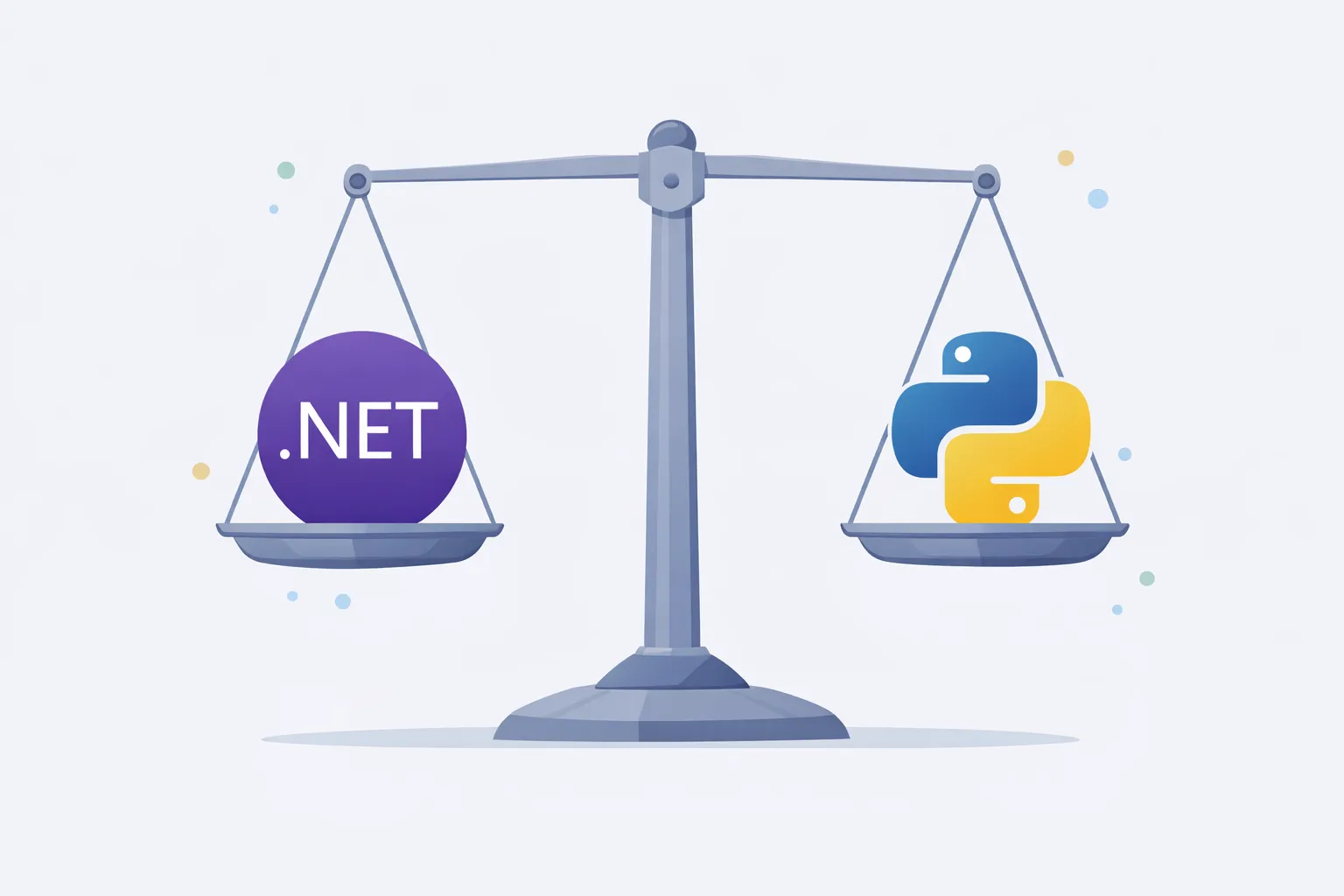
Let’s look at concrete examples: C#/.NET and Python. Not because they are “better,” but because they are common choices with very different profiles.
4.1. When C#/.NET makes sense
C#/.NET shines in Microsoft corporate environments, where integration is seamless. It benefits from static typing and powerful tooling. For high-performance APIs, it delivers strong results with ASP.NET Core. The ecosystem includes middleware, dependency injection, and observability libraries.
The trade-off is the cost and learning curve.
4.2. When C#/.NET would not be my first choice
I would avoid .NET if coupling to the Microsoft ecosystem is a problem or if the team is not familiar with it. For startups that need lightweight bootstrapping, a more minimalist stack may be faster.
4.3. What I would consider instead of C#/.NET
Alternatives:
- Node/TypeScript: ideal for JS/TS teams, with high initial productivity.
- Go: for services focused on concurrency and deployment simplicity.
- Python: better for data-driven or ML contexts.
4.4. When Python makes sense
Python excels in data-driven contexts: ETL, analytics, and ML. Its scientific ecosystem is unmatched. Frameworks such as FastAPI and Django REST make it easier to create APIs.
It is a good choice when the team comes from a data or data science background.
4.5. When Python would not be my first choice
If the backend needs to be extremely fast or CPU-bound, Python can be limiting. In large codebases, without type discipline, problems emerge at runtime. For a single, simple runtime at the edge or in serverless environments, Python may not be ideal.
4.6. What I would consider instead of Python
Alternatives:
- C#/.NET or Java/Kotlin: robustness and a well-established ecosystem.
- Go or Rust: aggressive performance and small footprints.
- Node/TypeScript: deep integration with the frontend.
Consider a hybrid architecture to combine strengths.
5. Frameworks matter as much as the language
5.1. The impact of the framework on daily work
Frameworks define:
- authentication, validation, and routes;
- database access and test organization.
“Opinionated” frameworks such as Rails and Django establish conventions that accelerate the start. “Micro” frameworks such as FastAPI and Express are more flexible, but require more decisions.
5.2. Example: ASP.NET Core vs. Python frameworks
- ASP.NET Core offers a well-defined pipeline, which is ideal for maintaining consistency, but it has a steeper learning curve.
- Django is comprehensive and works well for projects that fit its model. FastAPI is lighter and more modern, but requires more configuration.
The important question is not only “C# or Python?” but also “ASP.NET Core or Django/FastAPI?”
5.3. Where AI fits into framework selection
AI is excellent for learning frameworks:
- route, middleware, and validation examples;
- code snippets for common patterns.
But you should understand the framework’s strong opinions to avoid creating a Frankenstein of patterns.
6. Choosing a stack without rushing: a fast MVP ≠ a rushed decision
6.1. The myth that “anything goes for an MVP”
With AI, it is easy to fall into the “anything goes for an MVP” mindset. But even MVPs need to be viable in the long term. If the MVP is truly disposable, make that choice consciously.
6.2. Common mistakes when choosing a stack
Common pitfalls:
- Imitating a famous company without understanding its context.
- Underestimating operational complexity.
- Overestimating the team’s ability to learn.
- Ignoring the company’s existing strengths.
6.3. A simple decision framework
Use this quick process:
Step 1: Clarify the context
Define the product type, stage, requirements, and time horizon.
Step 2: Map the team
List current skills and appetite for learning.
Step 3: Filter 2–3 stack options
Remove options that do not align with constraints or cost.
Step 4: Compare using objective criteria
Evaluate productivity, ecosystem, cost, and hiring ease.
Step 5: Run a short experiment
Implement a feature using one of the candidates and measure the results.
Step 6: Make a conscious decision and document the trade-offs
Choose a stack and document the reasons and trade-offs.
7. Real examples of context-driven stack decisions
7.1. Growing B2B SaaS: .NET vs. Node/TS
Context:
- Product: B2B contract management SaaS.
- Stage: validated and growing product.
- Team: 8 developers, half using .NET and half using Node/TS.
- Infrastructure: Azure, AD, and SQL Server.
The decision was to consolidate the core on C#/.NET and keep Node/TS in BFFs close to the frontend, with AI support to speed things up.
7.2. Data and ML product: Python vs. the standard corporate stack
Context:
- Product: risk-scoring platform.
- Stage: strategic, with many experiments.
- Team: strong in Python, less experienced with C# or Java.
- Infrastructure: data lake with Python pipelines.
The decision was to build scoring services in Python, integrating them with the .NET core through APIs. Here, AI helped create the services’ skeleton.
8. Summary table: comparing stacks in context
| Stack | Where it typically shines | Initial productivity | Maintenance in larger teams | Cost / operational complexity | Contexts where it usually fits well |
|---|---|---|---|---|---|
| C#/.NET | High-performance APIs, core corporate systems | Medium/high (when the team knows it) | Very good: strong typing, robust tooling | Medium: efficient runtime and rich ecosystem, but heavyweight | Microsoft environments, core products with strong SLAs, corporate integrations |
| Python | Data/ML, ETL, model APIs, automation | High (especially for data work) | Depends on type and testing discipline | Variable: less efficient runtime, simple operations | Data-driven platforms, teams with many data scientists |
| Node/TypeScript | BFFs, web APIs, frontend integrations, I/O-bound services | High for JS/TS teams | Good with TypeScript and good practices | Medium: broad ecosystem, with many packages to manage | Web startups, products with strong frontend needs, full-stack squads |
| Go | Highly concurrent services, infrastructure tools | Medium: simple language, more low-level ecosystem | Good: lean code and simple conventions | Good: lightweight binaries, simple deployment, efficient runtime | Small containerized services, edge, performance-focused backends |
Use this table as a starting point for reflecting on your context.
9. Conclusion: AI as a decision accelerator, not a substitute for judgment
Backend stack choice in the AI era requires nuance. AI makes it easier to get started, but it makes engineering even more important.
There is no universally “right” stack. Each stack is better suited to a given context: product, team, and infrastructure. C#/.NET, Python, Node, and Go—all have their place and their moment.
The next time you choose a stack, do not fall into the temptation of following a favorite language or copying famous companies. Focus on:
- understanding the product context;
- analyzing what the team actually knows well;
- comparing options objectively;
- using AI as an accelerator, not an oracle.
And if you would like to exchange ideas and learn more, join our community!
Next steps
- Write down the context of a product or service you are creating: product type, stage, and requirements.
- List the stacks that make sense for you and compare productivity, ecosystem, cost, and alignment with the team.
- Choose a feature and run a quick experiment using AI to generate the skeleton and assess clarity, testing, and observability.
- Bring it to the team for discussion, focusing on business and operational context.
- Join the SCCB community to exchange ideas and follow upcoming events:
- Join the SCCB community — https://instagram.com/software_craftsmanship
- See upcoming events — https://instagram.com/software_craftsmanship