
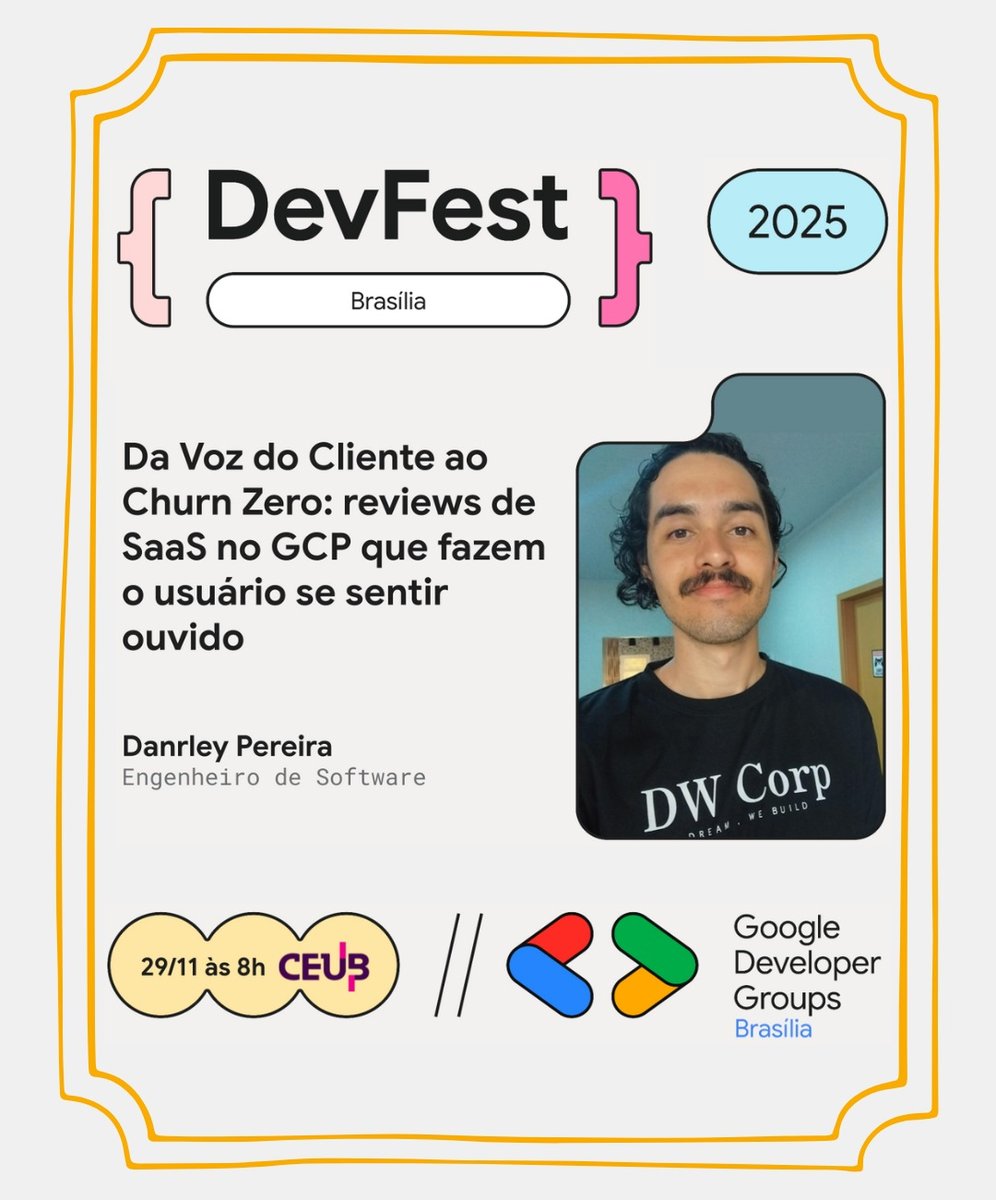
DevFest is one of those events that exists because of people. Organized by the Google Developer Groups (GDG) community, it brings together developers, students, and curious minds to exchange knowledge openly, without a stage reserved for major brands. In that spirit, DW Corp, together with the Software Craftsmanship Community Brasília (SCCB), took the stage at DevFest Brasília to share an idea we carry into our daily work: listening to customers is not a cost—it is retention.
The stage: a Google community in Brasília
The presentation was delivered by Danrley Pereira, a software engineer and SCCB leader. The talk had a straightforward title: From Customer Voice to Zero Churn — SaaS reviews on GCP that make users feel heard. There was no distant theory. The conversation started with a problem familiar to anyone who has ever canceled a service.
The thesis: every ignored complaint is a churn threat
The sentence that opened the talk summed it all up: every ignored complaint is a churn threat. The reasoning is simple. Many companies collect feedback but do not act on it. A customer complains, no one responds, and the feeling of not being heard becomes a reason to cancel. Add slow customer support, and you have the perfect recipe for losing people.
The economic detail that is often overlooked is this: retaining a customer costs less than acquiring a new one. In other words, taking care of the people who are already with you is not just about being considerate—it is a business decision. Based on this premise, DW Corp built a review tool that we use internally across all our services and also offer as a micro SaaS product to customers in Brazil and the United States.
How to truly act on feedback
Collecting opinions is easy. The difficult part is turning every message into something actionable, quickly and without relying on someone to read everything manually. The solution presented uses an event-driven architecture on Google Cloud.
Without getting into the code, the logic is as follows: every piece of feedback becomes an event. A messaging system, Pub/Sub, distributes that event to whoever needs to respond. Responses are stored in a structured, auditable way in BigQuery, while an artificial intelligence layer—Vertex AI—performs sentiment analysis, automatically distinguishing satisfied customers from those who are about to leave.
As a result, the complaint does not remain forgotten in an inbox. It triggers a response. And, just as important as the technology, the solution was designed with security and governance in mind: access is designed around the principle of least privilege, so each part of the system can do only what it needs to do—nothing more.
Observability: without it, your product is just an MVP
One of the talk’s most candid sections focused on operations. The message was clear: without observability, your product is nothing more than an MVP. A polished architecture is of little use if you cannot see what happens when something goes wrong.
That is why the system includes logs and monitoring alerts, as well as queues for messages that failed—known as Dead Letter Queues—and an alert that notifies the team as soon as something gets stuck. The metric that ties everything together has a human name: time to respond to the customer. In the end, that is what determines whether a person feels heard.
What we took away from DevFest
More than presenting a tool, our goal in attending DevFest Brasília was to contribute to the community. Events like this show that open knowledge becomes more valuable when it circulates. We brought a real-world case, including its successes and limitations, and came back with exchanges that only an in-person gathering can provide.
The closing statement still applies to any product, regardless of its size: listening is not a cost—it is retention. If your application collects feedback, the question that remains is an honest one: are you acting on that voice, or simply filing it away?