

Imagine a technical community that grew quickly. At first, three people could handle everything: organizing meetups, answering messages, inviting speakers, dealing with unexpected problems, and still remembering where that “final-now-it-works-version2.pdf” file was.

It worked. Not because it was the best model in the world, but because there was energy, closeness, and little complexity.
Then a few months pass. Invitations, partnerships, new volunteers, calendar expectations, and questions arrive—questions that no longer fit improvisation: should we hold more events or improve the experience of our current meetups? Who decides? What gets postponed? What seems urgent but is not a priority?
This is the point where institutional planning in practice stops being a polished document and becomes a tool for healthy survival. Not to “look professional,” not to earn an imaginary organizational maturity badge, but to align decisions, distribute responsibilities, and prevent every choice from depending on the memory or availability of the same people.
A good institutional plan does not need to be large. It needs to be used.
TL;DR
- An institutional plan is not an organizational presentation or a leadership wish list.
- It should connect mission, priorities, objectives, initiatives, and an ongoing review routine.
- Mission, vision, and principles only help when they work as decision-making criteria.
- Goals need evidence, but not everything needs to become a number.
- People responsible for initiatives need autonomy, context, and real execution capacity.
- The plan should be reviewed at lightweight intervals; changing the plan is not failure.
- The format can be simple: a shared one-page document, a board, or a short document.
- The main test is: does the plan help you say “yes” intentionally and “no” with clear criteria?
Institutional planning in practice: a decision-making tool
A common mistake is treating an institutional plan as synonymous with an organizational presentation. A presentation explains who you are to people outside the organization. An institutional plan guides how people inside it make decisions.
It is also not the same as abstract strategic planning, full of broad statements that could belong to any organization, from a startup to a cheese producers’ cooperative. Most importantly, it should not be a wish list created in a single meeting and then forgotten in a shared folder.
In practice, an institutional plan creates shared reference points about:
- what the initiative exists to do;
- which priorities matter now;
- which objectives will be pursued;
- who leads each area;
- how decisions will be reviewed;
- what will be set aside, even if it is interesting.
This applies to a small company, a technical community, a volunteer project, an internal team, or a growing initiative. In all these contexts, a moment arrives when “we’ll just keep going” is no longer enough.
The risk is producing a lengthy document to “formalize” the initiative without defining how it will be used in the decisions of the following month. It is like buying a sophisticated planner and continuing to write appointments on a napkin.
The central point is simple: an institutional plan only has value when it changes how decisions are made.
Start with context: what problem does the initiative exist to solve?
Before writing a mission, vision, or objectives, understand the context. Otherwise, you risk producing elegant statements disconnected from reality.
A few questions can help:
- Who is served or affected by the initiative?
- What concrete need exists?
- What resources are already available?
- Which constraints matter: time, budget, people, knowledge, legitimacy?
- Which responsibilities have already been assumed?
- What changes if the initiative ceases to exist?
That last question is often uncomfortable, but useful. If the answer is “almost nothing,” perhaps the initiative still lacks clarity about its contribution. If the answer is “many people lose an important point of support,” then there is something to preserve and improve.
A real purpose does not need to sound grand. “Help developers in the region practice, share experiences, and build professional connections” is more useful than “change the world through technology” when the subject is deciding on a calendar, meetup format, budget, and responsibilities.
Mission, vision, and principles as decision-making criteria
Mission, vision, and principles should not be decoration on an “about” page. They work best as decision-making criteria.
Mission describes the current contribution and who it exists for.
Example:
Create recurring spaces for learning and exchange among software professionals in Brasília.
Vision points toward a desired direction within a defined horizon.
Example:
Within two years, become a community with regular meetups, distributed organization, and active participation from people with different levels of experience.
Principles help guide decisions under pressure.
Example:
We prefer sustainable meetups to a packed calendar that always depends on the same people.
Consider a technical community deciding between increasing the number of events and investing in smaller meetups with continuity and active participation.
Without criteria, the discussion can become a matter of personal preference: “large events provide more visibility” versus “small events are more welcoming.” With a clear mission and principles, the question changes: which option better strengthens the contribution we want to make now?
If a community is inspired by the values of practice, continuous learning, and professional responsibility, those values should also appear in how it organizes itself. It makes little sense to advocate for collaboration, continuous improvement, and technical care while the initiative itself operates opaquely, overloads its organizers, and depends on a handful of people.
The main concern here is not to copy the mission, vision, and values of larger organizations. A sentence can be beautiful and still be useless. If it does not help you decide what to do next week, it is probably still too generic.
Turn institutional direction into a few verifiable objectives

After understanding the context and direction, you reach the part that separates intention from execution: choosing objectives.
A simple alignment chain might look like this:
mission → strategic priorities → objectives → initiatives → review routine
The mission provides meaning. Priorities indicate focus. Objectives make that focus verifiable. Initiatives organize the work. The review routine keeps everything alive.
Good objectives generally meet four criteria.
1. They are relevant to the purpose
They do not exist merely because someone saw another organization doing the same thing.
If an objective does not connect with the initiative’s central contribution, it may be interesting, but it will probably compete for energy with something more important.
2. They fit the current capacity
Ambition without capacity becomes frustration with meeting minutes attached.
This does not mean thinking small. It means recognizing time, people, budget, maturity, and context before making commitments no one will be able to sustain.
3. They require choices
If everything continues to be done in the same way, perhaps it is not an objective but a statement of desire.
A real priority changes the calendar, budget, focus, conversations, and responsibilities. If nothing changes, the priority probably exists only in the document.
4. They can be tracked through evidence
Evidence does not always need to be a number, but it must allow for honest evaluation.
A plan with too many priorities does not prioritize anything. When everything is strategic, nothing is strategic. For small or growing initiatives, three to five real priorities are usually more useful than a long list of important topics.
For example, instead of defining “strengthen the community,” a more practical priority might be:
Increase participant retention and develop new organizers to reduce dependence on the initial group.
This priority already suggests concrete paths: improve onboarding, create support roles, document essential processes, track repeat attendance, and invite interested people to join the organizing team.
Goals, metrics, and qualitative signals
Goals help, but they can also get in the way when chosen carelessly.
There are at least three types of evidence you can track:
-
Activity metrics: what was done.
Example: meetups held, materials published, organizing meetings. -
Outcome metrics: what changed in behavior or operations.
Example: people returning to meetups, new volunteers taking on tasks, reduced dependence on a single person. -
Impact signals: broader effects that are often harder to measure.
Example: participants reporting that they applied what they learned, made connections, or gained professional clarity.
Not everything needs to be numerical. In a technical community, recurring feedback, participant stories, and organizers’ observations can complement the numbers. On the other hand, measuring only “how it feels” can make decisions too subjective.
The trade-off is clear: measuring too little can leave the plan vulnerable to unsupported opinions; measuring too much can turn the initiative into a reporting machine. No one joins a community project excited to fill out spreadsheets as if serving a sentence.
Another consideration: goals are not immutable promises. If the context has changed, reviewing goals is a sign of responsible management, not failure. The problem is not adjusting the plan; the problem is pretending nothing has changed while reality is setting the kitchen on fire.
Turn objectives into initiatives, responsibilities, and routine decisions
An objective only comes to life in practice when it generates organized work.
For each priority, define at least:
- initiative or workstream;
- expected outcome;
- person responsible for leading it;
- people who support it or need to be consulted;
- deadline or review cycle;
- available resources;
- dependencies and risks.
For example, suppose a community wants to improve onboarding for new volunteers.
One initiative could be:
Initiative: create a minimum onboarding flow for new volunteers.
Expected outcome: interested people understand how they can contribute and can take on small tasks without depending on improvised conversations.
Responsible person: one organizer leads the design of the flow.
Support: two people review the materials and test the process with new volunteers.
Deadline: first version in four weeks.
Resources needed: welcome document, list of starter tasks, question channel, and introductory conversation schedule.
Evaluation criterion: new volunteers can choose an initial task and know whom to contact when they get stuck.
Notice that this does not require a heavy structure. It requires clarity.
Responsibility is not centralization
Having one person responsible does not mean concentrating all execution in that person. It means someone is looking after the workstream, ensuring it moves forward, decisions are made, and blockers become visible.
Without an owner, the initiative becomes “everyone’s.” And, often, “everyone’s” means “no one’s, but with the blame distributed democratically.”
On the other hand, responsibility without autonomy is a trap. There is no point assigning a workstream to someone if they cannot make decisions, have no time available, do not understand the objective, or need permission for every small step.
Good agreements make the following explicit:
- what the person can decide on their own;
- when they need to consult others;
- which limits apply;
- which outcome matters most;
- how to ask for help.
There is a trade-off here. More detailed plans reduce ambiguity in the short term, but can quickly lose usefulness in contexts that change frequently. Therefore, the level of detail should match the risk and stability of the context.
A critical and expensive workstream needs more clarity. A small experiment may work with lighter agreements.
Create a review cadence that keeps the plan alive

The value of a plan lies less in its publication and more in its use cycle. An institutional plan that is never reviewed becomes a museum piece: it may look nice, but no one should have to depend on it to cross the street.
The cadence should be lightweight and proportional to the size of the initiative. One possible model:
- Short, frequent operational check-ins: weekly or biweekly, to remove blockers and adjust tasks.
- Monthly or bimonthly initiative reviews: to assess progress, evidence, and necessary decisions.
- Broader priority reviews: quarterly, semiannually, or at another interval appropriate to the context.
The most important questions are not “what is the status?” or “is it green, yellow, or red?” Those questions can help, but they are insufficient.
Better questions include:
- What moved forward, and what evidence do we have?
- What is blocked?
- What has changed in the context?
- Is it still worth investing in this priority?
- What did we learn?
- What decision needs to be made now?
Imagine an expansion goal: the initiative wanted to increase the number of events, but realized that the team’s capacity was being consumed by maintaining the existing operation.
A mature review might conclude that the next cycle’s priority is not expansion but stabilization: document processes, distribute responsibilities, and reduce dependence on a few people.
That is not “moving backward.” It is stopping the pretense that unlimited capacity exists.
Record decisions, not just status
Many review processes fail because they record tasks but not decisions. After a few weeks, no one remembers why a priority changed, why an initiative was paused, or who took on a particular commitment.
Simple records help preserve continuity:
- decision made;
- reason;
- alternatives considered;
- person responsible;
- review date;
- expected impacts.
This is especially important in communities, volunteer projects, and growing initiatives, where people’s availability varies. The plan reduces dependence on individual memory and prevents every newcomer from having to excavate the organization’s oral history as if on an archaeological expedition.
The risk is turning the review meeting into a group reading of task lists. If the conversation does not address deviations, risks, and decisions, it is probably consuming time without improving execution.
Avoid patterns that turn planning into decoration
Decorative planning is planning that exists but does not guide behavior. It may even be beautifully laid out, with attractive icons and a respectable color palette. Still, if it does not change decisions, it is decoration.
Warning signs include:
- the plan does not connect with the budget, calendar, or people’s capacity;
- the objectives seem ambitious but have no success criteria;
- the priorities do not indicate what will be left undone;
- the document is inaccessible, too long, or written in language only leadership understands;
- no one knows when the plan will be reviewed;
- reviewing the plan is seen as weakness;
- owners have been assigned without autonomy;
- metrics encourage harmful behavior.
That last point deserves attention. If a community measures only the number of events, it may encourage a packed and exhausting calendar, even if quality declines and the organization becomes overloaded. If a team measures only delivery volume, it may encourage rushing without learning.
Metrics are invitations to behave in certain ways; choose them carefully.
There is also an important trade-off concerning transparency. Broad transparency increases alignment and trust. However, some topics require appropriate access levels, such as personal data, sensitive negotiations, conflicts, or financial information that has not yet been consolidated.
Being transparent does not mean exposing everything to everyone all the time. It means communicating what people need to understand the direction, criteria, and decisions.
And perhaps the most important point: reviewing the plan is not a failure of planning. A plan is an organized hypothesis about how to move forward. When new data emerges, adjusting the hypothesis is part of the work.
A practical path for creating or recovering an institutional plan
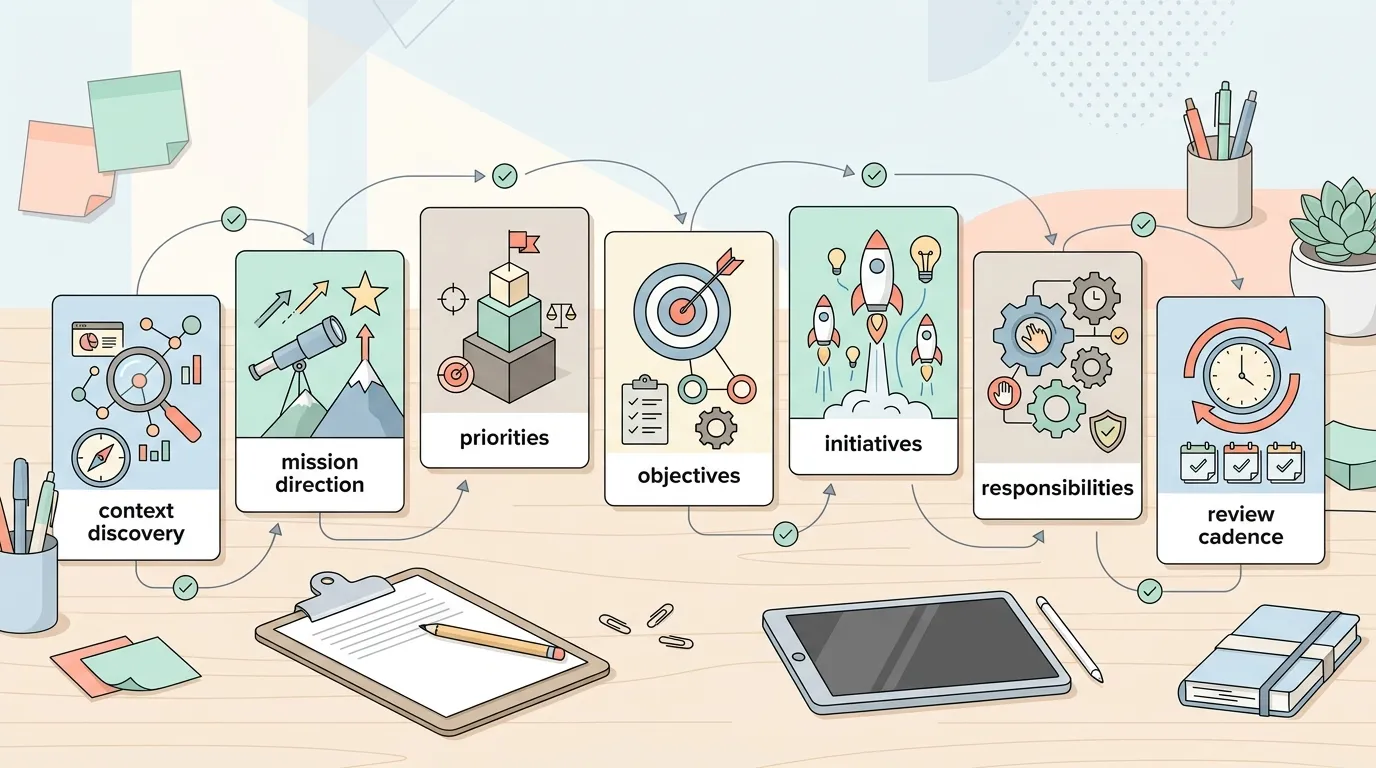
If you are starting from scratch or trying to recover a forgotten plan, follow a simple path.
1. Gather context, needs, and constraints
Before writing objectives, talk with the people involved, observe the current operation, and list real constraints. Include available capacity, existing commitments, risks, and recurring pain points.
Useful question:
What problem do we need to solve now for the initiative to remain relevant and sustainable?
2. Make the mission, direction, and principles explicit
Write simply:
- who the initiative exists for;
- what contribution it makes today;
- what direction it wants to follow within a defined horizon;
- which principles should guide difficult choices.
Avoid statements that could apply to any organization. If a sentence does not help you decide, rewrite it.
3. Choose three to five real priorities
A real priority requires giving something up.
For each priority, ask:
- what will this change in practice?
- what will we stop doing or do less of?
- why now?
- do we have the minimum capacity to sustain this choice?
If no one can answer, it may not yet be a priority; it may simply be a wish.
4. Define objectives, evidence, and owners
For each priority, define verifiable objectives. Include metrics when appropriate, as well as qualitative signals.
Example:
Priority: improve community continuity.
Objective: increase repeat participation and develop new organizational support.
Evidence: people returning to meetups, new volunteers taking on small tasks, feedback indicating that participants understand how to get involved.
Owner: person or group responsible for leading the cycle.
Review: a defined date to assess progress and make adjustments.
5. Organize initiatives for the current cycle
Turn objectives into workstreams. Do not try to solve the entire year at once if next month is already unclear.
For each initiative, record:
- expected outcome;
- next steps;
- owner;
- support;
- dependencies;
- risks;
- review date.
6. Set the first review
A plan without a review date is born with an expired shelf life.
Schedule the first review conversation before finishing the plan. It can be brief, as long as it produces decisions.
7. Communicate the plan in an accessible format
The format can be simple:
- a shared one-page document;
- a tracking board;
- a short document;
- a concise presentation for initial alignment.
A minimum one-page structure could contain:
markdown
Institutional plan — current cycle
Purpose
Why do we exist, and who do we serve?
Cycle priorities
- Priority A
- Priority B
- Priority C
Objectives and evidence
- Objective:
- Expected evidence:
- Metrics or qualitative signals:
Ongoing initiatives
- Initiative:
- Owner:
- Support:
- Deadline or cycle:
- Dependencies:
Risks and pending decisions
- Risk:
- Decision needed:
Next review
Date: Participants:
The format matters less than the connection between decisions and execution. A one-page document used frequently is worth more than a flawless PDF that no one opens.
In the end, an institutional plan is useful when it helps an initiative say “yes” intentionally and “no” with clear criteria.
Next Steps
If you want to put an institutional plan into practice without turning it into a corporate saga, start small:
- Bring together the people most involved and list the initiative’s real problems.
- Write a simple mission connected to the people you serve.
- Choose up to five priorities for the next cycle.
- For each priority, define an objective, evidence, owner, and review date.
- Record decisions somewhere accessible.
- Review the plan at the agreed interval and adjust without drama.
If you take part in technical initiatives or communities, or want to exchange experiences with people who are trying to better organize collective work, join the SCCB community.
To follow meetups and opportunities for conversation, see SCCB’s upcoming events.