
Machine Learning has become synonymous with “intelligence,” “the future,” and a whole collection of fancy words that explain nothing. At its core, the idea is much simpler than the hype suggests—and knowing when NOT to use ML matters just as much as knowing how to use it.

What Machine Learning is (and isn’t)
In traditional code, you write the rules: if age > 18 then adult. With Machine Learning, you do the opposite—you give examples to the computer and let it discover the rules on its own.
That’s it. No consciousness, no magic. An ML model is essentially a function that takes input data and produces a prediction, adjusted based on thousands of examples you showed it earlier. If the examples are bad, the prediction will be bad. Garbage in, garbage out—only now there’s a layer of mathematics on top.
Supervised vs. unsupervised learning
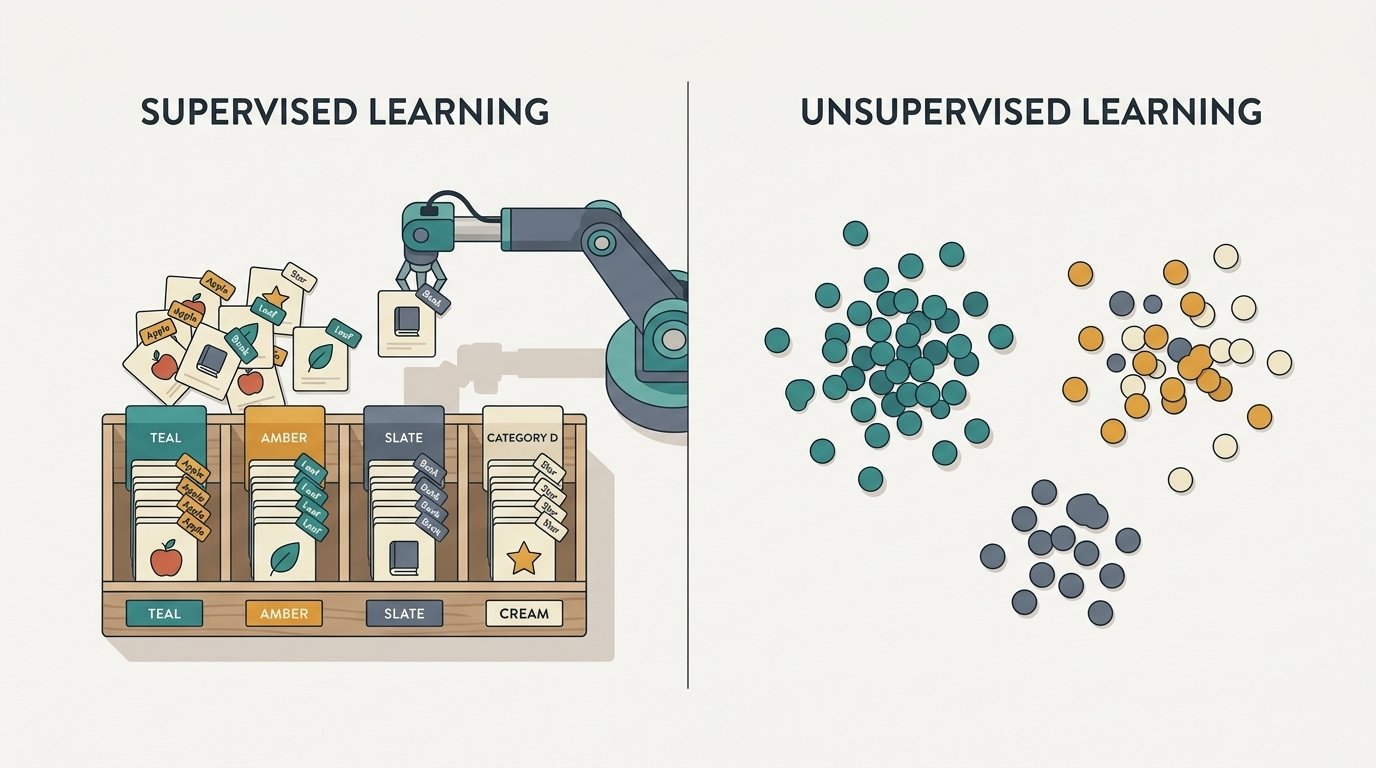
The most basic distinction in ML depends on one question: do you have the correct answers or not?
In supervised learning, you do. Each example comes with a label: this picture is of a cat, this email is spam, this house sold for $400,000. The model learns to map an input to an output. By far, this is the most commonly used type in day-to-day applications.
In unsupervised learning, you don’t have labels. You provide the data and ask the algorithm to find patterns—grouping similar customers, for example, without telling it in advance which groups exist. It’s useful for exploration, but harder to evaluate because there’s no answer key to check against.
Features and labels: the vocabulary that matters
Two terms appear all the time. Features are the inputs, the characteristics you use to predict something: the house’s size, neighborhood, and number of bedrooms. A label is the answer you want to predict: the price.
Here’s the part nobody tells you: choosing and preparing good features often produces better results than switching algorithms. A simple model with thoughtfully designed features will outperform a sophisticated model fed with garbage. Most of the real work in ML is precisely this—taking care of the data, not playing with neural networks.
Training, validation, and testing: why split the data
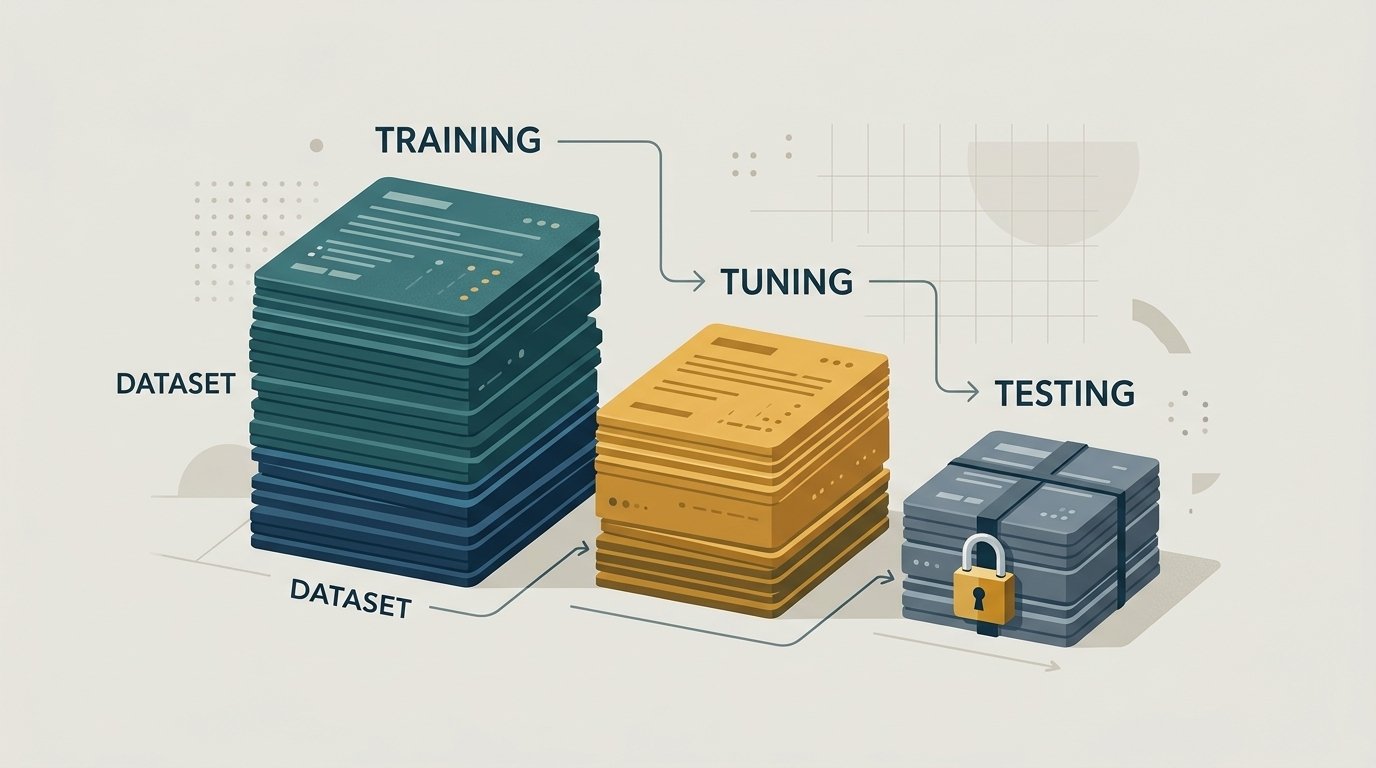
If you train and test the model on the same data, it looks like a genius—and fools you. Memorizing isn’t learning.
That’s why data is divided into three parts. The training set is where the model learns. The validation set is used to tune settings and compare options without contaminating the final result. And the test set is kept locked away until the end, used only once to measure how the model performs on data it has never seen. It’s the closest you can get to simulating the real world before putting a model into production.
Overfitting: when the model memorizes instead of learning
Overfitting is the classic nightmare. The model learns the training examples so well—including their noise and coincidences—that it performs wonderfully on the training data and poorly on any new data.
Think of a student who memorizes the exercise sheet instead of understanding the material: they get a perfect score on the same worksheet and freeze when faced with a different exam. The solution is that separate test set, which exposes the problem, along with simpler models that have less room to memorize. When choosing between a simple model and a complex one with similar performance, go with the simple one.
When NOT to use Machine Learning
This is the part the hype hides. ML isn’t the default answer—it’s often the more expensive and fragile one.
If the rules of the problem are known and stable, write the rules. A three-line if statement is faster, cheaper, and infinitely easier to debug than a model nobody understands. ML also won’t help when you have little data, when the data is poor quality, or when you need to clearly explain every decision for legal reasons.
The honest question before starting any ML project is: can this be solved without ML? If so, solve it without ML. Save Machine Learning for problems where the rules are too complex or change too often to write by hand—image recognition, demand forecasting, or filtering spam that reinvents itself every week. That’s when it truly shines.
Machine Learning is a powerful tool and, like every powerful tool, dangerous in the hands of someone using it just because it’s fashionable. Learn the concepts, respect the data, and above all, have the courage to choose the if/else when it’s the right answer.