

Four people I closely supported completed DW-Corp’s mentorship program and were then hired as software engineers at technology companies. Three of them started at mid-level, skipping the junior stage. I am writing this to honor those results—which belong to them, not me.
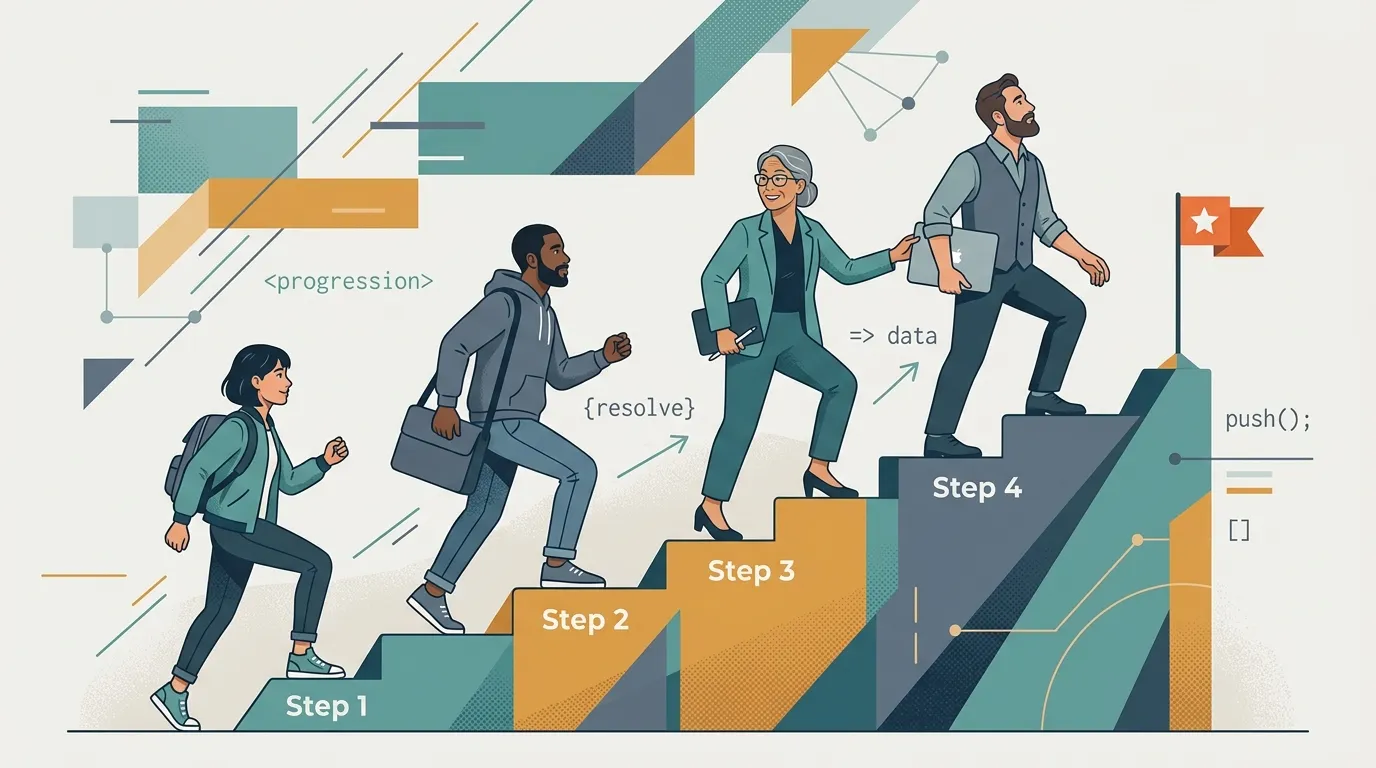
Four names, one common starting point
Guilherme Amaral, Polyana Cunha, Gabriel Faria, and Suyanne Miranda. Each arrived with a different background and a different routine, but they all had the same question in mind: can I really become a software engineer? In their case, the answer was yes—and faster than the usual path tends to suggest.
My role as a mentor was never to hand them a finished result. It was to help each person build a solid technical foundation, gain autonomy, and prove through their work that they were ready. The credit for each hire belongs to the person who sat down and did the work.
How the mentorship worked in practice
There was no simply watching lessons and moving on. The focus was deliberate practice: identify a weakness, work on it intentionally, receive direct feedback, and repeat until it became second nature. Without this cycle, studying turns into an accumulation of content that never really sticks.
The second pillar was real-world projects. Not lab exercises, but problems with ambiguous requirements, architecture decisions, and code that had to be maintained and reviewed. This is the kind of work that brings someone closer to what a company actually expects from a software engineer.
Guilherme, Polyana, and Gabriel: why they started at mid-level
All three were hired at mid-level, without going through the junior stage. That is not a minor detail. The market often treats junior as a mandatory step—and for many people, it is. But when someone arrives with the autonomy to take a problem from end to end, read legacy code without getting lost, and defend a technical decision, the junior label no longer makes sense.
It was not luck or magical talent. Guilherme, Polyana, and Gabriel arrived at their interviews already solving mid-level problems because they had trained for exactly that. Deliberate practice on real-world projects made their first day on the job feel like something they had already experienced dozens of times.
Suyanne: a beginning that is also a victory
Suyanne Miranda was hired as a junior software engineer—and I insist on placing this result on the same podium as the other three. Earning an engineering role means opening a door that many people spend years trying to reach. The entry level does not diminish the achievement; it is the starting point of a career that is now in motion.
Every journey has its own pace. What matters is that Suyanne entered the market as an engineer, with the foundation to grow from there.
What really shortened the path
If I had to sum it up, I would use three words: mentorship, deliberate practice, and real-world projects. None of them alone makes the leap happen. Mentorship without practice becomes conversation. Practice without a real project becomes an exercise disconnected from the world. A project without feedback becomes effort that does not correct its course.
Together, these three things helped three people enter the market at mid-level and a fourth open the door as a junior engineer. This is not a guaranteed formula for anyone—it is what worked for them, with a great deal of effort on their part.
What remains
Guilherme, Polyana, Gabriel, and Suyanne each proved in their own way that it is possible to arrive prepared. They were the ones who studied, practiced, and withstood the pressure of the interviews. I was simply fortunate enough to follow them closely. Let this be a message to anyone in the middle of the journey who has doubts: the leap exists, and it has a name—yours.