
There is a comfortable lie we tell ourselves: that good developers are born ready. That some magical talent separates people who write clean code from those who write spaghetti. I spent far too long believing that—until I joined Software Craftsmanship Brasília (SCCB) and realized that this is a craft. A craft is something you practice.
Programming is a craft, not a gift
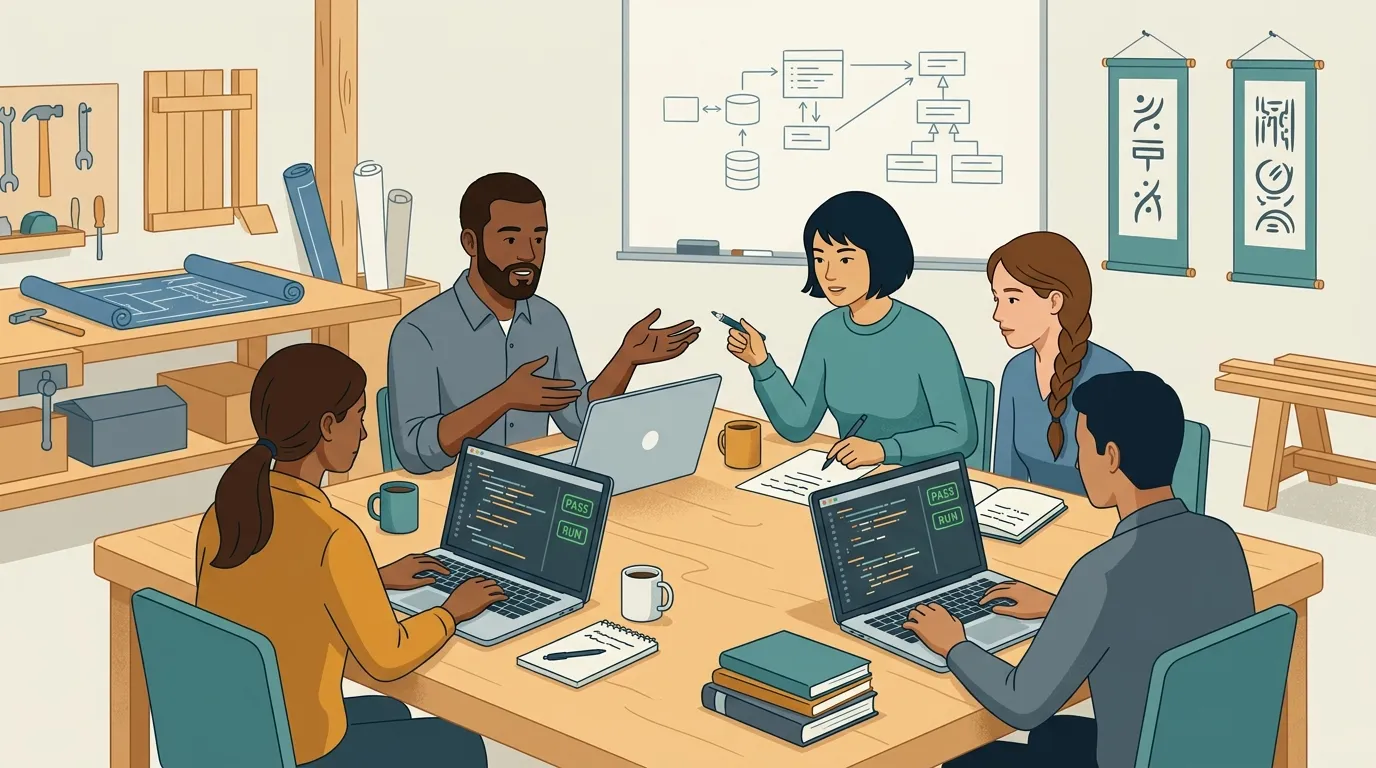
Software craftsmanship means treating programming as a craft: work you improve through deliberate practice, not luck. SCCB is a community that does exactly that—it brings people together in synchronous in-person and remote meetups to solve katas together and share their solutions afterward.
This is not LinkedIn philosophy. It is people sitting together, solving the same problem, comparing approaches, and discussing why your solution turned out better than mine.
What the heck is a kata?
Kata is a term borrowed from martial arts: an exercise you repeat to sharpen a movement. In code, it is a well-defined little problem that you solve again and again—not to “finish,” but to practice how you solve problems.
We draw katas from sources such as kata-log.rocks and Codurance. The point is not finding the right answer. It is paying attention to your decisions: where you overcomplicated things, where you skipped a test, and where you could have simplified. Repeating the basics with attention is what separates someone with five years of experience from someone who has repeated the same year five times.
Practicing together beats the solo grind
Studying alone has a ceiling. You cannot see your own habits, no one challenges your “good enough,” and feedback takes weeks—when it arrives at all.
In the community, feedback is immediate. Someone looks at your code and asks, “Why did you do it this way?” Sometimes you defend your choice; sometimes you realize you did not even know why. That friction is learning in action. Practicing in a group turns mistakes into conversation, and conversation into shared standards—something no YouTube tutorial can deliver.
The principles we live by (not just quote)
SCCB follows a set of principles that show up in every kata. Not as slide decoration—as practices we hold each other accountable to:
- YAGNI and KISS: do not build what nobody asked for, and keep things simple.
- DRY: do not repeat knowledge throughout the codebase.
- Red-Green-Refactor (TDD): a failing test, code that passes, code that improves—in that order.
- SOLID and Clean Code: design that can handle change and code the next person can understand.
- AAA (Arrange-Act-Assert) to structure tests, and Given-Should-Then to name tests in a way that tells a story.
These acronyms become habits when you practice them in a community, with someone beside you pointing out when you ignore them.
How DW-Corp turns this into real training
At DW-Corp, we do not treat this as a weekend hobby—it is how we train and calibrate professionals. The logic is straightforward: if craftsmanship is learned by practicing together, then we create an environment where that can happen.
In practice, that means four things. Recurring katas, so everyone keeps their skills sharp. Pairing, because two minds working on the same problem learn faster than four eyes on separate screens. Real code review, where the question is “why,” not just “approved.” And shared standards—the principles above become the team’s common vocabulary, so “is this DRY?” is a question everyone understands in the same way.
The result is junior developers who progress in months through what would take years alone, and senior developers who stay sharp because teaching is the best way to avoid getting rusty.
If you are in Brasília and tired of studying alone while banging your head against the wall, show up. We share our solutions, our Instagram is open, and the truth is that nobody becomes good at coding in isolation. A craft is learned collectively—and the best day to start practicing was yesterday. The second best is the next meetup.