
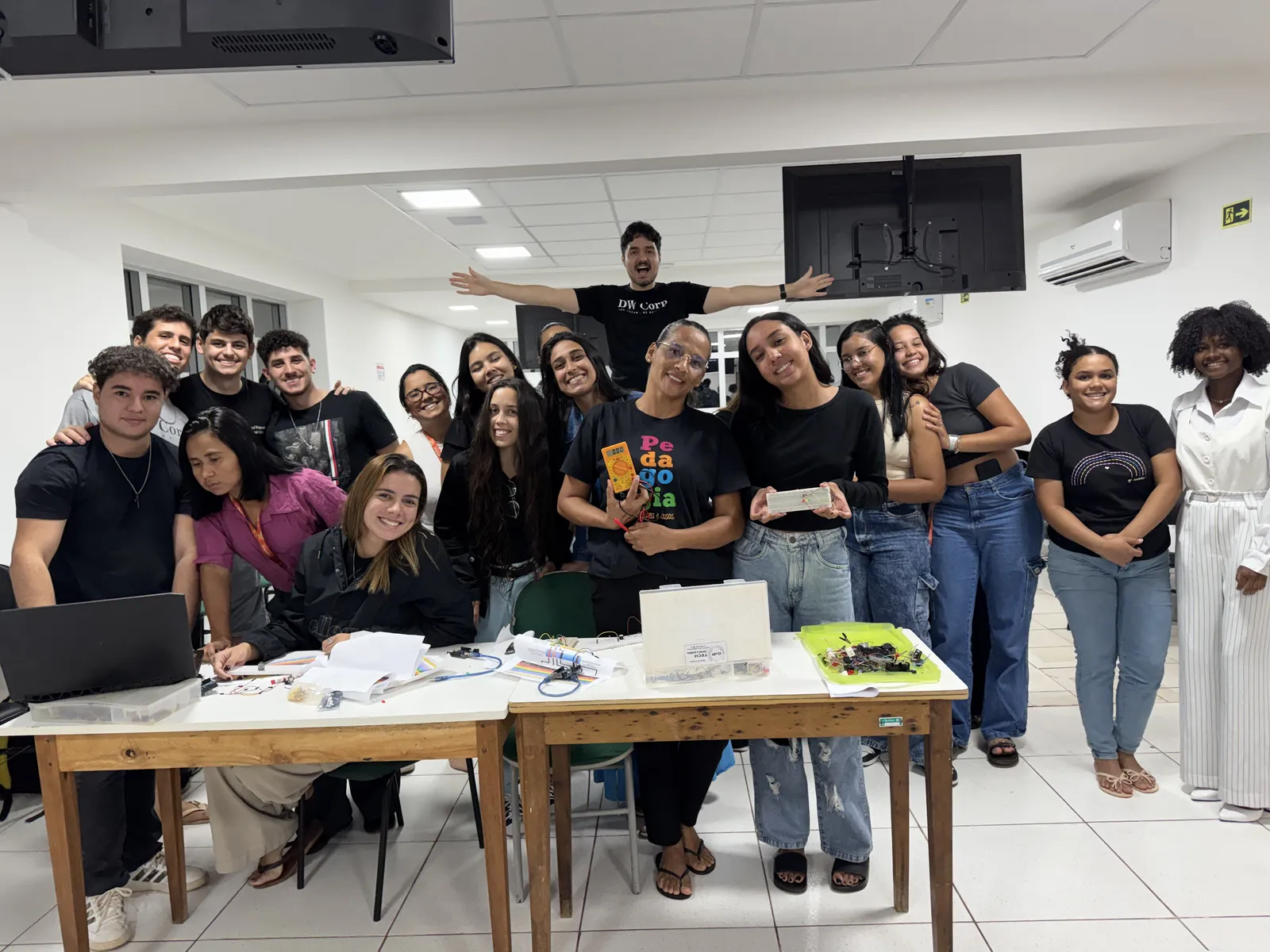
The first time an LED lights up, controlled by code written with one’s own hands, it produces a smile that is hard to forget. That was the smile DW Corp set out to find in 2026, when it brought the “Arduino and 21st-Century Education” workshop to teacher-training students at Uniceplac Gama. The idea was simple and bold at the same time: get future teachers programming hardware and, through that experience, transform the way they will teach.
Why hardware belongs in teacher education
Educating in the 21st century is about much more than transmitting content. It is about awakening curiosity, teaching problem-solving, and showing that technology is not a magical black box, but something people can understand and build. When a future teacher assembles an Arduino circuit, they learn more than electronics: they experience firsthand what it means to try, make mistakes, adjust, and finally see something work. That is the experience they will be able to recreate tomorrow with dozens of students.
Hardware takes programming out of the abstract and brings it into the physical world, where the result lights up, moves, and can be measured. For those who will educate new generations, that is invaluable.
The workshop at Uniceplac Gama
Arduino is a small prototyping board that has become a worldwide symbol of technology education precisely because it is accessible, affordable, and beginner-friendly. At Uniceplac Gama, the board became a bridge between computing and teacher education. The students—many of whom had no previous programming experience—were guided from the ground up: from the first circuit concepts to the moment they uploaded their own code to the board.
The goal was never to train electronics engineers. It was to show these future educators that they are capable, and that they can bring this same sense of discovery to the classrooms where they will teach.
Learning by doing
The workshop followed the best of DW Corp’s approach: little disconnected theory and plenty of guided practice. Company and community volunteers moved between the workstations, answering questions, helping participants find the misplaced wire, and celebrating every circuit that worked. This close support makes a difference: no one gets stuck alone, and the fear of “not having a knack for it” dissolves after the first small victory.
Pro bono as a value
The initiative was entirely pro bono, and that is not a minor detail. Education and social impact are among the values DW Corp takes seriously, and bringing technical knowledge to those who educate teachers multiplies that impact in a way few initiatives can. Every teacher-training student reached is a seed: throughout their career, they will carry the experience into countless classrooms.
What remains
At the end of the day, what remains is not just the memory of the lit LED. It is the certainty planted in each future teacher that technology is learned by doing—and that they are fully capable of teaching in the same way. Preparing those who prepare others is perhaps the most beautiful way to believe in education. That is exactly what happened in Gama.